Author: bpmukadmin

  • How Much Do Custom Embroidered Patches Cost? (A Complete Cost Breakdown 2027)

    How Much Do Custom Embroidered Patches Cost? (A Complete Cost Breakdown 2027)

    The price for custom embroidered patches starts around £0.39 and can reach £51.66 for a single patch. The final cost depends on the patch size, the total quantity ordered, and the amount of embroidery coverage.

    For example, if you order 2,000 pieces of a 1-inch patch with 50% coverage, you’ll pay about £0.44 each. On the other end, a short run of ten 7-inch patches with 100% coverage will cost roughly £51.66 per patch.

    Patch Makers UK has no minimum order requirement. They provide free digitising, free delivery across the UK, and will send you a full quote within one business day based on your specific artwork.

    The Science Behind Embroidered Patch Costs

    3-Inch Embroidered Patch Pricing

    Here is the per-patch rate for a 3-inch patch, based on quantity and coverage:

    Coverage 10 pcs 50 pcs 100 pcs 500 pcs 1,000 pcs 2,000 pcs
    50% £12.42 £2.81 £1.87 £0.92 £0.62 £0.59
    75% £13.63 £3.09 £2.04 £1.02 £0.69 £0.66
    100% £14.86 £3.36 £2.23 £1.12 £0.74 £0.72

    Keep in mind that complex artwork might change your quote slightly.

    Calculating Patch Cost and Size

    Size, quantity, and coverage all affect the price. To find your patch size category, add the height and width, then divide by two. A patch that is 2 inches high and 4 inches wide falls into the 3-inch category.

    The Patch Makers UK website has a calculator that shows live pricing ranges based on size, quantity, coverage, and backing type, helping you estimate costs before requesting a quote.

    How to Determine the Custom Embroidered Patch Prices? 

    Several factors determine the cost of a custom patch. Understanding these can help you lower the price without changing your design.

    Patch Size (1 to 7 Inches)

    Size is the main factor in patch pricing. Larger patches require more backing material, thread, and machine time. A 2-inch patch for a cap is on the cheaper end, while a 4-inch patch for a jacket sits in the middle. Back patches over 7 inches require multiple embroidery passes and are quoted individually.

    Quantity and Bulk Orders

    Setting up the embroidery machine has an upfront cost that is split across your entire order. Ordering more patches lowers the cost per piece. The largest price drop happens between 20 and 300 pieces. If you plan to order again later, buying a larger batch upfront will save you money.

    Embroidery Coverage (50%, 75%, 100%)

    Coverage refers to how much thread fills the patch compared to the exposed twill backing. This has a major impact on the price.

    • 50% coverage leaves the twill visible and is the cheapest option.
    • 100% coverage covers the entire fabric with thread and costs the most.
    • 75% coverage is a popular middle ground.

    Lowering coverage from 100% to 75% or 50% is a direct way to cut costs.

    Thread Colours

    Every extra thread colour requires the machine to stop and load a new spool, which adds to the cost. Most standard orders include 6 to 12 colours. Reducing the number of colours in your design will lower the price.

    3D Puff Embroidery

    3D embroidery costs more than flat embroidery. It uses a foam layer under the stitches to create a raised effect, requiring extra stitches and more production time. Metallic and glow-in-the-dark threads also cost more.

    Backing Type

    • Sew-on backing is usually the cheapest and is included in the base price.
    • Iron-on backing adds a small fee for the adhesive layer.
    • Peel-and-stick backing costs slightly more than iron-on patches.
    • Velcro backing is the most expensive standard option because it requires an extra layer of material.

    Border Style

    • Merrowed borders (classic overlocked stitching) are the standard and cheapest option.
    • Hot-cut borders (heat-sealed edges) suit intricate shapes and cost a bit more.
    • Laser-cut borders provide the most precise edge for irregular shapes and are the most expensive.

    Custom Embroidered Patch Prices by Size 

    Pricing by Size (100 pieces)

    Here are the benchmark rates for an order of 100 pieces across different sizes:

    Size 50% to 100% Coverage Range
    2 inches £1.39 to £1.66
    3 inches £1.87 to £2.23
    4 inches £2.40 to £2.88
    5 inches £3.19 to £3.87
    7 inches £6.12 to £7.45

    Prices increase with size because material and thread usage scale with surface area. Sizes are available in half-inch increments up to 7 inches. Anything larger requires a custom quote.

    Additional Custom Patch Costs and Fees 

    VAT and Hidden Fees

    Always check if a quote includes VAT before comparing prices. Ask for the full total to avoid surprises at checkout.

    Confirm if the following fees are included:

    • Digitising fee: The cost of turning artwork into an embroidery file. Patch Makers UK waives this on standard orders, but other suppliers may charge £20 to £60.
    • Rush production: Standard delivery is 7 to 10 business days. Expedited delivery (3 to 5 days) usually adds 15% to 30%.
    • Delivery: Patch Makers UK offers free delivery in the UK. Overseas suppliers might have hidden import duties or longer delivery times.
    • Oversized patches (7+ inches): These require custom quotes.
    • Revision fees: One or two mockups are usually free, but major design changes might cost extra.

    Choosing Between UK and Overseas Patch Makers? 

    Ordering from the best UK custom patch supplier helps you avoid import duties and customs delays. A cheaper quote from an overseas supplier might end up costing more once customs charges are added.

    Real Custom Embroidered Patch Pricing Examples 

    • Small Club Run: 100 patches, 3 inches, 75% coverage, sew-on backing. £2.04 per patch.
    • Corporate Rollout: 500 patches, 3 inches, 100% coverage, standard turnaround. £1.12 per patch.
    • Bulk Distribution Run: 2,000 patches, 3 inches, 50% coverage, sew-on backing. £0.59 per patch.

    Other Types of Custom Embroidered Patches 

    Embroidered patches are durable and have a traditional texture. If you want a different look, woven patches offer a flat, smooth finish with more detail. PVC rubber patches are bold and colourful with a 3D edge. Sequin patches provide an all-over sparkle.

    How to Estimate the Best Price for Custom Embroidered Patches? 

    1. Order in bulk. Rounding up your order (e.g., 90 to 100 pieces) can lower the per-patch rate.
    2. Simplify the design. Fewer colours mean less machine time and lower costs.
    3. Lower the coverage. Dropping to 75% or 50% coverage cuts costs without reducing the patch size.
    4. Skip 3D puff. Flat embroidery is cheaper.
    5. Choose standard shapes. Circles, ovals, and rectangles avoid extra die or laser-cut charges.
    6. Compare quotes. Check the full total, including VAT and digitising fees, not just the per-patch rate.

    Frequently Asked Questions

    How much do 100 custom embroidered patches cost?

    The price of custom embroidered patches, either 1 or 100 pieces, depends on the patch size and embroidery coverage. Large patches with detailed embroidery will naturally cost more, but ordering in bulk will help you reduce the cost per patch.

    Does embroidery coverage affect the price?

    Embroidery coverage does increase the price because a patch with more embroidery coverage will require more machine time. You can drop the coverage to 75% or 50%, which can make a major difference in cost without changing the patch size.

    Does ordering more patches reduce the price?

    Yes. Larger orders cost less per patch because more pieces can divide the setup and production cost. If you are aware that you will need more patches later, it is better that you order a bulk batch upfront and save per patch cost.

    Is there a minimum order for custom embroidered patches?

    Patch Makers UK has no minimum order requirement, so you can order a small quantity if you need a few patches only.

    Does the size of an embroidered patch affect its price?

    Yes, size affects the price of an embroidered patch because large patches use more backing material and thread and take longer to produce.

    Are there extra costs for custom embroidered patches?

    There can be an extra cost, depending on the supplier and your requirements, such as rush orders. Patch Makers UK provides free digitising and UK delivery on standard orders, but it’s still worth checking the full quote before comparing suppliers.

    Do I pay import duty when ordering embroidered patches?

    It depends on where you are ordering from. Buying from a UK-based supplier generally cuts the import duties and customs issues that can come with overseas orders.

    How long does it take to make custom embroidered patches?

    Production time depends on the order size, design complexity, and your delivery requirements. The standard turnaround is around 7 to 10 business days, while rush production can take around 3 to 5 days and may cost an additional 15% to 30%.

    Does the number of thread colours affect the price?

    It can affect the price because each additional thread colour may call for extra machine stops and setup, due to which production time and cost can increase. Simpler designs will help you lower the price.

    Is 3D puff embroidery more expensive than standard embroidery?

    Yes, 3D puff embroidery does cost more than normal flat embroidery because it uses a layer of foam underneath the stitches to create a 3D effect. This requires additional materials, stitching, and production time.

    Get the Best Value for Your Custom Embroidered Patches 

    Getting the best price for custom embroidered patches is not always about choosing the cheapest quote. Size, quantity, embroidery coverage, backing, thread colours, and extra fees can all change the final cost. You may want to keep your budget under control, so to save up some money you can order in bulk, choose the right coverage, simplifying your design also helps, and always compare the full quote.

    With Patch Makers UK, you can order any quantity with free digitising and delivery in UK. If you are ready to know your patch price, then you can get your free quote right today and start your order.

  • Custom Iron On Patches UK: Types, Uses & How to Order

    Custom Iron On Patches UK: Types, Uses & How to Order

    Do you want a patch that sticks to fabric with just heat? Custom iron on patches UK buyers pick them again and again.

    Patches have been used on clothing for a very long time, from military kit to school bags. No design experience is needed at all. You just need an idea, big or small.

    Maybe you run a small shop. Maybe you play for a local team. Maybe you just love patches. They are simple. They are quick. And they look sharp on almost anything you own.

    Today, almost any UK business, club, or family can order one easily online. The process has become far simpler than it used to be, with quick proofs and fast delivery.

    This guide is for anyone who wants iron on patches custom UK wide, made just for them. We will show you every type, every use, and every size you can choose.

    You will also learn how easy it is to get your own custom made iron on patches made today. Many shoppers search for the best iron on patches custom uk has to offer. 

    What Are Custom Iron-On Patches?

    A custom iron-on patch is a small piece of fabric art. It carries your own design. You can put your logo on it. You can put a name on it too. 

    You can even put a small picture, a badge shape, or a fun symbol on it. The back of the patch has a special glue layer. This glue is called heat-activated backing.

    Heat from an iron makes the glue melt and stick to cloth. It is a strong bond. You do not need a needle or thread. No sewing skill is needed at all to iron patches onto clothes.

    That makes iron-on patches a great pick for anyone in a hurry. These patches come in many custom sizes. You can pick tiny or huge.

    They also come in many shapes. Circles, squares, and odd custom shapes are all possible. Colours can match almost any brand palette or team colour scheme.

    Custom Iron-On Patch Types

    There are four main types of custom patches iron on which shoppers can choose from. Each type looks different. Each type feels different too.

    Custom Embroidered Iron-On Patches

    Embroidered patches use coloured thread to build the design, stitch by stitch. The thread sits above the fabric. This gives it a raised, textured feel.

    Thin lines and tiny text can get lost in thread, so keep the design bold and clear. Custom embroidered iron on patches also tend to feel very durable, since the thread is tightly stitched It looks classic and strong. 

    They hold their shape well, even after years of daily wear. Many people think of this style first when they hear the word “patch”.

    Custom Woven Iron-On Patches

    Woven patches use much thinner thread than embroidery. This lets fine details show up clearly, even tiny text or small letters.

    If your logo has small letters or thin lines, woven is a smart pick. The finish is flatter than embroidery. It feels smooth under your fingers.

    Woven patches also work well when a design has many small colour blocks close together. Gradients and shaded areas can look neat in a woven finish too.

    This type suits modern, detailed logos that need to stay sharp at a small size. Many brands pick woven patches when embroidery cannot copy every small detail.

    Custom Printed Iron-On Patches

    Printed patches use ink rather than using thread to build the design. This means full colour is possible and even photo-like images too on the surface.

    This style also tends to feel flat and smooth, much like a printed sticker on fabric. Gradients and complex art all print clearly on this type and also shading. 

    Custom PVC Iron-On Patches

    PVC patches are made from soft, rubber material that is bendy. They feel bouncy, almost like a small rubber badge, and bold to the touch.

    PVC patches often have a 3D feel. Rain, mud, and sweat do not harm them easily. This makes PVC a strong pick for outdoor gear and rough, daily use. The colours also tend to stay bright for a very long time.

    Some buyers skip iron-on backing for PVC because they prefer attaching PVC patches without an iron and use another method instead.

    What Can You Put Custom Iron-On Patches On?

    You can add a patch to almost any piece of cloth. Here are the most popular spots people choose.

    • Jackets are a top pick for patches. A jacket patch adds instant style to any outer wear, from denim to bomber styles.
    • Hoodies work well too. The chest, sleeve, or back all make good spots for a patch.
    • Uniforms often use patches for names and job titles. This keeps a whole team looking neat and matching.
    • Workwear gets patches for safety marks and company branding. It helps customers know who they are speaking to.
    • Sportswear also loves patches, though care is needed with stretchy, shiny fabric. Man-made cloth needs a slightly different heat setting, like polyester, require some tips.
    • Denim, for iron-on patches, is one of the best fabrics. Its thick weave holds heat very well and glue too.
    • Bags get a fun, personal touch from a patch. A plain bag suddenly feels one of a kind.
    • Backpacks too, especially for school runs, travel, or festivals, are great.
    • Clothing brands, to build a look that fans want to wear and show off, use patches.
    • Aprons, tote bags, and even soft toys can also carry a small patch nicely.
    • Caps and beanies work too, though a slightly curved or smaller patch often sits better there.

    Custom Iron-On Patches for Different Uses

    Patches are not just for one type of person or group. Many different buyers use them. One at a time, let’s walk through the most common groups.

    Businesses & Workwear

    A patch with your logo makes staff look like one true team. It builds trust at a glance, since customers can spot staff.

    Small businesses, before moving to full uniforms, start with a simple patch often. Cafes, garages, cleaning firms, and trades all use patches on shirts and jackets.

    A neat patch, rather than a printed logo alone, can feel more professional. New starters, once they get their own branded item, also feel part of the team faster.

    Sports Teams & Clubs

    Teams, on shirts and bags, use patches, also on tracksuits and jackets. Patches help fans and players feel proud to belong to their club.

    Many clubs, for supporters to collect as merchandise, also sell small patches. Coaches and volunteers often get their own patch too, showing their role. 

    Junior teams, as a small reward for finishing a season, love patches. Away kits and training gear can also carry a smaller version of the same badge.

    Schools & Organisations

    Schools add patches to bags and blazers for a smart look and jumpers for a shared feel. Clubs and groups for badges, events, and member kits use patches.

    Scout groups and youth clubs are long-time fans of the humble iron-on patch. Parent groups sometimes order patches as a small fundraiser too.

    Motorcycle Clothing

    Bikers, on jackets, vests, and backpacks, love biker patches. Since biker gear takes a lot of wear, it helps to know how to stop a patch peeling off too soon.

    A strong biker patch, for many years of riding, can show club pride. Many riders from different trips, rallies, or clubs over time collect patches.

    Fashion & Clothing Brands

    Small fashion brands use patches to make plain clothes feel special and unique. A single patch can turn a basic top into a limited, collectable item.

    Streetwear labels often use bold, colourful patches as a signature touch. Some brands even release a new patch design each season, like a mini collection.

    Independent sellers at markets also use patches to add a handmade, personal feel to their stalls.

    Events & Merchandise

    Festivals and events use patches as fun, wearable keepsakes. Guests love taking home something small they can wear again and again.

    Charity events also use patches to thank volunteers and raise a little extra money. Weddings, birthdays, and reunions sometimes use a custom patch as a quirky gift too.

    Conference organisers occasionally hand out patches instead of the usual paper name badge.

    Custom Iron-On Patch Sizes and Shapes

    You are not stuck with one shape or size. There are many choices out there.

    • Circular patches suit round logos and badges very well.
    • Shield shapes feel bold and classic, great for crests and badges. Large shield patches often sit on a jacket back, much like a back patch.
    • Rectangle and square shapes suit text, slogans, and name patches.
    • Logo-shaped patches follow the exact outline of your own artwork, with no extra border.
    • Name patches are small, simple, and perfect for uniforms and workwear. Many buyers search for custom iron on name patches for exactly this reason.
    • Small patches suit hats, pockets, collars, and sleeves.
    • Large patches suit jacket backs, bag fronts, and big group logos.

    If you only need a patch for headwear, you can also ask about custom iron on hat patches shaped to fit any cap or beanie. Many buyers also want custom iron on patches for hats in a smaller, slightly curved shape, since caps are not flat.

    How to Choose the Right Custom Iron-On Patch

    Still not sure which type fits your project? This table makes it simple to decide.

    Requirement Recommended Option
    Traditional logo Embroidered
    Small detailed artwork Woven
    Photographic/full-colour design Printed
    Outdoor/heavy-use application PVC
    Uniform branding Embroidered/Woven
    Fashion artwork Embroidered/Printed

    Getting Your Artwork Ready for a Custom Patch

    A little prep work before you order can make the final patch look even better. Simple, clear artwork almost always turns into a stronger, sharper patch.

    Try to avoid tiny text under a certain size, since it can blur once stitched or printed. Colour matching and bright, bold colours tend to stand out more from a distance is also worth a thought

    If you have a logo EPS or PDF file already, a vector format like AI also works best. No vector file? A large, clean image can still be used in most cases.

    Common Mistakes to Avoid When Ordering Custom Iron-On Patches

    A few small mistakes can affect how a finished patch turns out.

    • Picking a size for a detailed design that is too small is the first mistake.
    • The second mistake is choosing the artwork that is wrong for patch type.
    • Forgetting to think about the patch will sit on which fabric is the third mistake.
    • The fourth mistake is rushing, skipping the proof stage and going straight to production.
    • For a growing team or event, the fifth mistake is ordering too few patches.
    • When something feels unclear, the sixth mistake is not asking questions.
    • Where the patch will actually sit on the garment, forgetting to plan that is the eighth mistake.

    How to Order Custom Iron-On Patches in the UK

    Ordering custom made iron on patches is simple once you know the steps.

    Submit Your Artwork

    Send us your logo, design, or idea. Simple sketches work too.

    Choose Patch Type

    Pick embroidered, woven, printed, or PVC based on your design.

    Select Size and Shape

    Tell us your preferred size and shape. Custom shapes are always welcome.

    Confirm Quantity

    Order one patch or a thousand. We accept iron on patches custom UK no minimum orders, so small runs are always welcome.

    Review Artwork Proof

    We send a free digital proof. You can check colours and details before production starts.

    Approve Production

    Once happy, simply approve the proof. Production begins right away.

    Receive Your Patches

    Your finished patches arrive ready to iron onto any garment.

    Why Choose Custom Iron-On Patches?

    No sewing kit or skill is needed because Iron-on patches are easy to apply. Exactly how you want, you can design them with any custom shape or colour. 

    For any garment or project, they come in flexible shapes and sizes. To look consistent and sharp at every event, teams and businesses use them. 

     A patch can match perfectly in every garment, across a whole group, giving consistent branding.

    Patches, do not weigh down a jacket or bag are also light and thin, so they. Into any parcel, they travel well too, since a small patch fits easily.

    Iron-On vs Other Patch Backings

    Out there, iron-on is only one of several backing choices that require different methods to apply.

    Sew-on backing is stronger and lasts longer through heavy, frequent washing.

    Velcro backing lets you swap patches on and off between garments with ease.

    Magnetic backing works with zero holes and zero heat at all.

    Each backing suits a different job, so think about how the item will be used and washed.

    Custom Iron-On Patches for UK Businesses

    Businesses across the UK rely on patches every single day.

    • Staff uniforms look sharp with a small logo patch placed on the chest or sleeve.
    • Company branding grows stronger when every worker wears the exact same mark.
    • Workwear patches also help customers spot staff quickly in a busy shop or site.
    • Promotional merchandise, like tote bags or caps, gets a nice lift from a neat patch.
    • Events use patches as small gifts that guests remember long after the day ends.
    • Clubs use patches to mark members, ranks, or special milestones.
    • Retail and fashion brands add patches to stand out on a crowded shelf.
    • Hotels and other hospitality teams also lean on patches for staff uniforms.

    Bulk orders are simple to arrange too. Whether you need ten or ten thousand, wholesale custom iron on patches are easy to plan with the right supplier.

    FAQs

    Can I order custom iron-on patches with my logo?

    Yes. Just send over your logo and our team will turn it into a patch. Custom logo iron on patches is our most popular order by far. We can also tidy up rough or low-quality logo files at no extra step for you.

    What designs can be made into custom iron-on patches?

    Almost any design works well. Logos, names, small art, and even photos can all become a patch. Simple, bold shapes usually give the cleanest final result.

    What sizes can custom iron-on patches be?

    Patches can be tiny or quite large. You simply tell us the size your project needs. Most buyers pick a size based on where the patch will sit on the garment.

    Can custom iron-on patches be made in any shape?

    Yes. We can cut a patch into almost any shape that follows your design outline. Rounded corners tend to hold up slightly better than very sharp points.

    What is the best type of custom iron-on patch for a logo?

    Embroidered patches usually work best for simple, bold logos and clean shapes. Woven or printed can suit logos with fine detail or many colours instead.

    Can I order custom iron-on patches in bulk?

    Yes. We offer wholesale custom iron on patches for large teams, schools, and businesses. Bulk orders still get the same free proof and quality checks as smaller ones.

    Do you make custom iron-on patches in the UK?

    Yes. We design and ship custom made iron on patches right here in the UK. Orders are handled by a real team from the first message to final delivery.

    How do I send artwork for a custom iron-on patch?

    Just email your file, or upload it directly through our simple online quote form. No file ready yet? A rough sketch or description is a fine place to start too.

    Final Thoughts on Custom Iron-On Patches

    A fun, easy way to show off your own style is custom iron-on patches. The process stays simple, whether you want one single patch or a huge batch.

    To biker clubs, from small businesses, a patch that fits, almost anyone can find one. Schools, sports teams, hotels, and fashion brands all use them in their own way too.

    Send over your design when you are ready, pick a type and pick a size. Before you reach out, there is no need to have everything figured out.

    Ready to make your own? Send over your design to Patch Makers UK and get started today.

  • Top 10 Best Custom Patch Companies in the UK [2026 Guide]

    Top 10 Best Custom Patch Companies in the UK [2026 Guide]

    Choosing between the many custom patch companies UK businesses can rely on is not a simple task. The market is crowded with suppliers who all claim to offer the best embroidery, the fastest turnaround and the lowest prices, but only a handful actually deliver on all three consistently.

    Whether you need custom embroidered patches UK for a uniform programme, custom PVC patches for outdoor workwear, or a short run of iron-on patches UK customers can apply themselves. This guide ranks the ten providers worth shortlisting in 2026.

    We evaluated each company against the criteria that actually matter to a buyer: stitching quality and material strength, minimum order quantity, pricing transparency, design support, and turnaround time. Read on for the full ranking of the best custom patch manufacturer UK businesses currently trading.

    How We Ranked the Best Custom Patch Companies in the UK

    Before diving into the list, it helps to understand what separates a good custom patch maker UK supplier from a great one. We looked at five core factors across every provider on this list.

    Quality and Material Options

    The best custom patches UK suppliers offer a genuine range of materials, including embroidered patches, PVC patches, woven patches, chenille patches and printed patches, each suited to different use cases. Stitching density, colour vibrancy and edge finishing were all assessed, since these details determine whether a patch survives repeated washing and daily wear.

    Minimum Order Quantity and Pricing

    A low or no minimum order quantity matters enormously for small businesses, clubs and individuals who only need a handful of patches. We favoured companies offering custom patches no minimum order policies and transparent bulk pricing tiers for larger commercial buyers.

    Turnaround Time and Design Support

    Fast production without sacrificing quality is a genuine differentiator. We also looked at whether each company provides a free digital design proof before production begins, since this reduces costly reprints and miscommunication.

    The Top 10 Best Custom Patch Companies in the UK for 2026

    1. Patch Makers UK

    Patch Makers UK tops this list as the most well-rounded custom patch company UK, and for good reason. The business combines fast production timelines with genuinely strong embroidery density, avoiding the loose-thread fraying that plagues many discount vendors.

    Patch Makers UK is particularly well suited to mid-tier corporate buyers, event organisers and clubs who need a dependable custom patch manufacturer UK partner that can process standard vector artwork quickly and accurately into a finished custom patch design.

    What sets Patch Makers UK apart is the balance it strikes between speed and craftsmanship. Clients get a free design proof before production, clear bulk pricing for larger orders, and a full range of embroidered patches, PVC patches, woven patches and iron-on options. For businesses that need custom patches UK without the guesswork, Patch Makers UK remains the benchmark the rest of this list is measured against.

    Best for: Corporate branding, uniforms, clubs and event organisers who need reliability at scale.

    2. Eagle Patches UK

    Eagle Patches UK is a strong second placement, distinguished by a more flexible minimum order policy that suits individuals and small groups ordering a single custom patch design rather than a bulk run.

    Where Patch Makers UK leans towards volume buyers, Eagle Patches UK positions itself as the more accessible option for hobbyists, motorcycle clubs and small teams who still expect professional-grade embroidery.

    The company offers a solid catalogue of custom embroidered patches UK options alongside morale patches and biker-style designs with thick twill backing, making it a genuine competitor for anyone who values low commitment over maximum production speed.

    Best for: Small orders, biker clubs, hobbyists and one-off custom patch designs.

    3. The Custom Patches UK

    The Custom Patches UK rounds out the top three with a broad product range covering embroidered patches, PVC patches and printed designs, backed by a straightforward online ordering process.

    The company markets itself heavily on affordability and free artwork proofing, which appeals to price-sensitive buyers ordering custom patches for clothing in moderate quantities.

    While the automated design workflow means less hands-on consultation than Patch Makers UK offers, The Custom Patches UK remains a dependable choice for retail, uniform and promotional patch orders where speed of checkout matters more than a guided design process.

    Best for: Budget-conscious buyers who want a fast, self-service ordering experience.

    4. Patches Maker

    Patches Maker has built a reputation as a UK-based embroidery factory offering iron-on and Velcro backing across a wide inventory of custom patches for clothing, hats and backpacks.

    The company is known for unlimited free revisions on design proofs, which reduces the risk of a costly reprint. Its strength lies in consistency across high wash-cycle durability, making it a reasonable option for workwear and uniform buyers who need patches that hold their colour over time.

    Best for: Workwear and uniform patches that need to survive frequent washing.

    5. Bespoke Patches UK

    Bespoke Patches UK focuses on tailored production with a strong emphasis on design accuracy, working closely with clients during the sampling phase before a full production run begins.

    The company covers morale patches, fabric patches, embroidered patches and PVC cotton badges, and its close-consultation approach suits buyers with complex or highly detailed artwork that needs careful translation into a finished patch.

    Best for: Complex artwork requiring hands-on sampling before bulk production.

    A man walking down a UK road wearing a denim jacket with custom patches

    6. CustomPatches.co.uk

    CustomPatches.co.uk offers a wide product spread, including embroidered, Velcro and plastic patches, supported by an AI-assisted design tool that lets buyers generate a rough mock-up before speaking to the team.

    The company promotes swift and dependable delivery alongside comprehensive after-sales service, positioning itself as a convenient option for buyers who want to experiment with a design before committing.

    Best for: Buyers who want to prototype a design quickly before ordering.

    7. Stitch Patches UK

    Stitch Patches UK has earned a reputation for speed, making it a strong choice for groups under time pressure who need custom patches UK without the delays associated with international shipping.

    The company’s domestic production base means shorter lead times than overseas competitors, though buyers with highly detailed artwork may find the design consultation process less thorough than higher-touch competitors on this list.

    Best for: Time-sensitive orders that cannot wait on international shipping.

    8. Masters Custom Patches

    Masters Custom Patches specialises in embroidered patches for clubs, organisations and military-style use, offering multiple backing options including iron-on. The company’s nationwide service and focus on structured, insignia-style designs make it a reasonable fit for organisations that need consistent, formal patch branding across multiple locations.

    Best for: Clubs, organisations and military-style insignia patches.

    9. Made By Cooper

    Made By Cooper appears consistently in independent comparisons of UK patch manufacturers, known for a boutique approach to smaller production runs. The company’s more limited catalogue is offset by closer attention to individual orders, which suits buyers who value personal service over the largest possible product range.

    Best for: Smaller boutique orders where personal service matters.

    10. Embroidery Badge UK

    Embroidery Badge UK closes out the list, offering flexibility and customer-focused service that particularly suits quick, small orders. The company’s willingness to accommodate low-volume requests makes it a sensible fallback option for buyers who have been turned away elsewhere due to high minimum order quantities.

    Best for: Low-volume orders that larger manufacturers tend to decline.

    How to Choose the Right Custom Patch Company for Your Order

    Selecting the best custom patch manufacturer UK depends heavily on the specific requirements of your project. For sports teams and clubs, look for producers of custom patches offering high-density embroidery and classic merrowed borders that withstand rough field use.

    For fashion brands and clothing labels, micro-threaded woven labels and chenille patches with sharp detailing tend to perform better. Corporate and uniform buyers should prioritise flexible ordering schemes and reliable heat-seal backing for easy application, while biker clubs and motorcycle groups need thick twill backing and weatherproof polyester stitching built to survive thousands of miles on the road.

    Pricing also varies significantly depending on size, colour count and material choice, so it is worth requesting a sample or mock-up before committing to a large custom patches bulk order UK. If you are working to a deadline, always confirm production and delivery timelines in writing before checkout.

    Why Patch Makers UK Leads the List

    Across every evaluation criterion, from embroidery density to design proofing to bulk pricing transparency, Patch Makers UK consistently delivers the most balanced package for UK buyers.

    The company avoids the two most common failure points in this industry: the loose stitching that comes from rushing discount orders and the impersonal, fully automated ordering experience that leaves complex artwork poorly translated.

    For businesses, clubs and event organisers who need a trusted go-to source for a high-quality custom patch company UK that gets the order right the first time, Patch Makers UK remains the strongest choice on this list.

    Frequently Asked Questions

    What is the best custom patch company in the UK?

    Patch Makers UK is widely regarded as the best overall custom patch company UK for 2026, thanks to its combination of fast turnaround, strong embroidery density and transparent bulk pricing. The company suits mid-tier corporate buyers, clubs and event organisers particularly well, since it processes standard vector artwork quickly while still maintaining the stitching quality that prevents fraying. 

    How much do custom patches cost in the UK?

    The cost of custom patches UK depends on size, material, thread type, backing option and order quantity. Small individual orders of embroidered patches typically cost more per unit, while bulk orders of fifty or more patches bring the per-unit price down significantly through tiered pricing. PVC and woven patches tend to sit at a different price point than standard embroidery due to the tooling and material costs involved. Most reputable suppliers, including Patch Makers UK, provide a personalised quote once they know your design, size and quantity, so requesting a free quote is the most accurate way to budget for a project.

    What is the minimum order quantity for custom patches?

    Minimum order quantity varies widely across UK custom patch manufacturer businesses. Some companies enforce a baseline minimum to keep production efficient for bulk corporate and uniform orders, while others explicitly market a no-minimum policy to appeal to individuals and small clubs ordering a single design. If you only need one or two patches, it is worth checking a supplier’s minimum order policy before requesting a quote, since providers built around bulk production may not be the most cost-effective option for very small runs.

    How long does it take to get custom patches made in the UK?

    Turnaround time for custom embroidered patches UK typically ranges from a few business days for domestic rush orders to several weeks for complex designs or very large bulk quantities. 

    Order Patches From UK’s Most Trusted Source

    Finding the right supplier among the many custom patch companies UK businesses have to choose from comes down to matching your priorities, whether that is turnaround speed, minimum order flexibility, or embroidery quality, against what each provider genuinely does best.

    Patch Makers UK earns the top spot on this list for offering the strongest overall balance of speed, stitching quality and transparent bulk pricing, making it the most trusted custom patch company UK for corporate buyers, clubs and event organisers heading into 2026.

    Whichever supplier you choose, request a design proof and a written quote before committing to a full production run. Contact us today to get a free quote for your custom patch order from our expert team.

  • Custom Embroidered Military & Regimental Patches: UK Buyer’s Guide

    Custom Embroidered Military & Regimental Patches: UK Buyer’s Guide

    For serving personnel, veterans, cadet units, and regimental associations, a patch is never just fabric and thread. Custom embroidered military patches carry the weight of a regiment’s history, its battle honours, and the loyalty of everyone who has worn its badge.

    Whether it is a Tactical Recognition Flash stitched onto a soldier’s right sleeve, a veteran’s association patch worn with pride at a reunion, or a reproduction cap badge mounted for display, these small pieces of embroidery do a great deal of work.

    They identify, they honour, and they connect. This guide walks UK buyers through everything worth knowing before commissioning regimental patches UK, from the history of unit insignia to choosing a supplier who will get the detail right the first time.

    Why Regimental Patches Matter in British Military Tradition

    The British Army has always been a collection of proud, distinct regiments, each with its own colours, customs, and visual identity. Custom patches exist to answer a simple but important question at a glance: who does this person belong to? A regimental patch does that job instantly, whether it is worn on a beret, a blazer, a stable belt, or a piece of combat kit.

    Beyond identification, these patches are a form of institutional memory. They encode heraldic devices that sometimes date back centuries, battle honours earned in specific campaigns, and colour schemes that mean something only to those who served.

    For veterans and associations, a well-made military patch UK reproduction becomes a way of keeping that connection alive long after the uniform is retired. For serving units, correctly specified patches are part of maintaining dress standards and unit pride on operations and on parade.

    A Short History of British Military Patches

    Understanding where today’s patches came from helps explain why accuracy matters so much when ordering custom regimental patches.

    Cap patches are the oldest and most recognisable form of British unit patches, historically cast in metal and worn on headwear to instantly mark a soldier’s regiment. Their designs, often drawing on heraldry, mottos, and historic emblems, remain closely guarded by regimental authorities to this day.

    Formation signs emerged during the First and Second World Wars as a way of marking division, corps, or higher formation identity on the battlefield, often in bold, simple, colourful shapes designed to be recognised at a distance. Though their battlefield use faded after 1945, formation signs remain a rich part of British military heritage and a popular subject for veteran and collector reproductions.

    The modern Tactical Recognition Flash, or TRF, grew directly out of this tradition. As combat uniforms moved to camouflage patterns where a metal cap patch could not always be worn or seen, the army introduced coloured cloth flashes, worn on the right arm, to identify a soldier’s regiment or corps at a glance.

    Many TRF colour schemes are drawn directly from a unit’s stable belt, tying the modern flash back to older regimental customs. Today, every cap badge, TRF, and formation sign in current use sits within a long, continuous line of British insignia design, and that lineage is exactly why reproduction and commemorative patches need to be handled with care and accuracy.

    Types of Military and Regimental Patches We Cover

    A single term rarely covers everything a UK buyer needs, so it is worth understanding the distinct categories before placing an order.

    Cap Badge Reproductions

    Cap badge reproductions translate a regiment’s traditional metal headwear patch into embroidered form, typically for display, blazer wear, or association use rather than as an issued item of uniform. These require careful attention to the fine detail of crowns, scrolls, mottos, and central devices, since even small proportion errors are immediately obvious to anyone familiar with the regiment.

    Tactical Recognition Flash (TRF) Patches

    TRF patches are the coloured flashes worn on the right sleeve of a combat uniform to identify a wearer’s regiment or corps. Colours and layout must match established regimental specifications precisely, since a TRF’s entire purpose is fast, unambiguous identification.

    Formation Signs

    Formation signs represent a brigade, division, or higher headquarters and are worn in addition to a TRF or cap badge, not instead of it. These are popular among veterans’ groups and collectors reproducing historic wartime formations, as well as current units maintaining formation identity.

    Veteran and Association Patches

    Veteran association patches cover the badges, blazer crests, and commemorative designs produced for regimental associations, standard bearers, and reunion events. These often blend traditional regimental heraldry with association-specific wording, such as branch names or anniversary dates, and typically carry more flexibility in sizing and backing than issue-pattern patches.

    Design Considerations for Accurate Regimental Embroidery

    Getting a custom military patch right comes down to three things: heraldic accuracy, correct colours, and stitch quality fine enough to render small detail cleanly.

    Heraldry accuracy is non-negotiable. Regimental patches are built from specific heraldic elements, crowns, scrolls, cyphers, mottos in Latin or other languages, and central devices such as animals, weapons, or emblems, and every element needs to be reproduced in correct proportion and orientation. A skilled digitiser working from a clear reference image or vector artwork will preserve these details rather than simplifying them away.

    Regimental colours carry meaning that goes beyond aesthetics. Many British units are strongly associated with specific colour pairings, and getting a shade even slightly wrong can make a patch look unfamiliar to the people who know the regiment best. We match thread colours against reference patches, official colour specifications where available, or existing patches supplied by the customer.

    Embroidery detail level, or stitch density and thread count, determines how much fine detail a design can actually hold. Intricate cap badge reproductions with small text or fine linework need a higher stitch count and smaller needlework than a simple bold formation sign. We advise on the right level of detail during the proofing stage so text stays legible and edges stay crisp, rather than blurring into a solid block of thread.

    A UK military custom patch under production at a patch-making facility

    Backing Options for Military and Regimental Patches

    The right backing depends entirely on where the patch is going to live.

    • Sew-on backing remains the standard for issue-pattern uniform items and formal association wear, offering permanent, secure attachment that will not come loose under regular movement or laundering.
    • Velcro or hook-and-loop backing is now standard for modern combat uniforms such as MTP kit, allowing TRFs and rank or trade patches to be swapped quickly between roles, courses, or units without re-stitching.
    • Iron-on backing suits merchandise, association memorabilia, and softer fabric items such as caps, bags, and casual clothing, giving a quick, no-sew application for members who want a patch without needing a needle and thread.

    We can also produce hybrid options, such as a sew-on patch with a Velcro loop panel added, for customers who want flexibility across different uses.

    Ordering Custom Military Patches in the UK

    Sizing, type and backing standards for custom patches are fairly consistent by category. TRFs typically run in the region of 5 x 4 cm; formation signs vary more widely depending on the original wartime or modern design. 

    Cap badge reproductions are usually produced to match the diameter or height of the original metal patch, commonly between 4 cm and 6 cm. We will always confirm exact dimensions against your reference before production begins.

    On permissions, it is worth understanding the landscape clearly. Official issue custom patches, including current-pattern cap badges, TRFs, and formation signs supplied for wear on the service uniform, sit under regimental and Ministry of Defence control, and procurement for those purposes runs through official channels rather than open commercial orders.

    What we produce for the private, veteran, association, and collector markets are commemorative and display reproductions; blazer patches; and merchandise-grade patches, which are a well-established and entirely separate category from issued kit.

    If you are ordering on behalf of a serving unit for anything other than personal or association wear, we recommend confirming with your regimental headquarters or supply chain that a commercial reproduction is the appropriate route for the intended use.

    Lead times for standard orders typically run five to ten working days from an approved digital proof, with rush production available for time-sensitive events such as reunions, remembrance parades, or anniversary dinners. Bulk regimental or association orders should be placed with extra lead time to allow for careful proofing of heraldic detail before full production runs.

    Choosing a Supplier for Military & Regimental Patches

    Not every embroidery supplier is set up to handle the accuracy that regimental patches UK customers expect, so it is worth being selective. A military uniform commands respect the moment you see it.

    Hence, it is necessary that the military patches attached to it are made by a patch maker who has expertise and can make them in high-quality finishes that do not fray and uphold the values of the military standards.

    Request a sample or digital proof first:

    A supplier confident in their heraldry and colour matching will happily produce a digital mock-up and often a physical sample for larger association orders before committing to full production.

    Check the minimum order quantity:

    Individual veterans and small associations often need a handful of patches, not hundreds, so look for a supplier who will produce low quantities without a punishing price penalty, alongside the capacity to scale up for full battalion or association-wide runs.

    Understand the price breakdown:

    Pricing is driven primarily by patch size, stitch count, and quantity. A small, simple TRF will cost considerably less per unit than a large, highly detailed cap badge reproduction with dense stitching, and per-unit pricing should drop meaningfully at higher order volumes. A transparent supplier will explain this breakdown rather than quoting a single flat number with no detail behind it.

    At Patch Makers UK, every regimental order goes through a proofing stage before production, giving you the chance to check heraldic detail, colour matching, and sizing against your reference patch before a single stitch is sewn.

    Frequently Asked Questions

    How much detail can be included in a small cap badge reproduction?

    Fine details like small text and intricate designs can be accurately reproduced in embroidery but depend on patch size and stitch count. Smaller patches require simpler designs for legibility. We suggest adjustments during proofing for clarity, ensuring the patch remains readable.

    What is the difference between a TRF and a formation sign?

    A Tactical Recognition Flash (TRF) indicates an individual’s regiment, while a formation sign denotes the higher unit. Both are worn together, with the TRF often featuring simple designs and the formation sign showcasing distinct patches for accurate historical representation.

    Can you match the exact colours of my regimental patch?

    Colour matching is crucial for accurate regimental patches. We use a physical patch, high-resolution photos, or official references to match embroidery thread shades, confirming matches with digital proofs while noting any non-exact matches and alternatives.

    Do I need permission to order a reproduction of my regiment’s patch?

    Commissioning a commemorative regimental patch for personal use or display generally does not require authorisation. However, orders for serving units related to official uniforms should consult regimental headquarters. Our team can assist with any uncertainties.

    Get Your Military & Regimental Patches Made Right

    Custom embroidered military & regimental patches deserve better than a generic embroidery run. Whether you need a single cap badge reproduction for a shadow box, a full set of TRF patches for a unit, or a run of veteran association patches for an upcoming reunion, the team at Patch Makers UK combines careful heraldic attention with UK-based production and fast turnaround.

    Contact us to request a free design consultation and quote today, and we will guide you through the sizing, backing, and colour matching before a single stitch is sewn.

  • Iron-On Patches for Hospitality & Hotel Staff Uniforms in the UK

    Iron-On Patches for Hospitality & Hotel Staff Uniforms in the UK

    A guest forms an opinion about a hotel within seconds of walking through the door, and staff appearance plays a significant part in that first impression. A sharp, consistent uniform signals professionalism, competence, and attention to detail, three qualities every hospitality brand wants associated with its name.

    One of the simplest and most cost-effective ways to achieve that consistency across a large team, spread across multiple departments and sometimes multiple properties, is through custom iron-on patches for hotel staff uniforms UK businesses can apply them quickly and reapply them as staff turn over.

    Iron-on patches have become a preferred option for UK hotels, restaurants, and wider hospitality groups because they solve a practical problem: how to brand a wide variety of garments, from front desk blazers to kitchen whites, without the cost and lead time of fully embroidered stock.

    This guide covers where iron-on patches are used across a hospitality business, how they compare with sew-on and direct embroidery, what to consider when designing them, and how the ordering process works for teams that need volume, consistency, and fast reordering.

    Why Hospitality Businesses Use Custom Patches on Staff Uniforms

    Brand Consistency Across Front-of-House and Back-of-House Teams

    A hotel or restaurant is rarely staffed by people wearing identical uniform stock. Front-of-house teams often wear blazers or tailored jackets, while housekeeping and kitchen staff wear more functional garments suited to their roles.

    Custom patches allow a single, consistent logo and colour palette to appear across every one of these different uniform types, tying the whole team together visually even when the base garments differ significantly.

    A Cost-Effective Alternative to Fully Embroidered Garments

    Commissioning fully embroidered uniforms for an entire hospitality workforce is expensive, particularly for businesses with high staff turnover or seasonal hiring. Iron-on patches deliver the same polished, embroidered look at a fraction of the cost, since the branding is produced once and then applied to as many garments as required, rather than embroidering each uniform individually.

    Easy to Apply Across Mixed Uniform Stock

    Hospitality uniforms rarely come from a single supplier. Jackets, aprons, polo shirts and chef whites often arrive from different manufacturers, in different fabrics and colours. Iron-on patches are garment-agnostic in a way that direct embroidery is not, meaning the same patch design can be applied consistently regardless of where the underlying uniform stock was sourced.

    Department and Role Differentiation

    Embroidered patches for hotel staff also give hospitality managers a simple way to differentiate departments and seniority. Housekeeping, concierge, and kitchen teams can each carry subtly different patch designs, colours, or wording while still remaining clearly part of the same overall brand.

    Where Iron-On Patches Are Used in Hotels and Hospitality

    Front Desk and Concierge Blazers

    Blazers worn at the front desk and by concierge staff are usually the most visible uniform items in a hotel, making the branding on them especially important. A well-placed chest or lapel patch reinforces brand identity every time a guest approaches the desk.

    Housekeeping Uniforms

    Housekeeping teams typically wear more practical, wash-resistant garments. Iron-on patches applied to tunics or polo shirts keep this team visibly connected to the hotel brand, even though their uniform style differs from front-of-house staff.

    Restaurant and Bar Staff Aprons and Polos

    Restaurant and bar teams often wear aprons over polo shirts with restaurant uniform patches applied to either garment to help reinforce brand recognition for guests dining or ordering drinks on site.

    Kitchen and Chef’s Whites

    Chef whites are a classic canvas for hospitality branding, with patches applied to the chest or sleeve. Kitchen teams frequently wear branded caps or skullcaps alongside their whites, and for hospitality groups sourcing headwear as well as patches, Caps Maker UK supplies custom embroidered chef caps designed to match.

    Doormen’s and Porters’ Coats

    Doormen and porters are often the first and last point of contact a guest has with a hotel. Patches on coat lapels or breast pockets help maintain a formal, branded appearance in this highly visible role.

    Porter, Valet and Doormen Caps

    Alongside coats, many hotels outfit porters, valets and doormen with branded caps. Because caps have curved, structured surfaces, embroidery generally performs better than an applied patch in this specific application.

    Spa and Leisure Staff Uniforms

    Spa and leisure teams typically wear softer, more relaxed uniforms than the rest of the hotel, but patches still allow this department to carry consistent branding without disrupting the softer aesthetic these uniforms are designed around.

    Iron-On vs Sew-On vs Embroidered Direct: Which Is Best for Hotel Uniforms?

    Choosing the right patch application method depends on the garment, the expected wash frequency and how quickly a hospitality business needs to roll out branding.

    Method Durability Cost Turnaround Best For
    Iron-on Good for moderate commercial washing; may need reinforcement for daily industrial laundering Lowest Fastest Blazers, aprons, polos, seasonal staff, multi-site rollouts
    Sew-on Excellent; withstands frequent industrial laundering Low to moderate Fast Uniforms washed daily, high-turnover roles
    Embroidered direct Highest durability; permanent Highest Slowest Long-term staff uniforms, headwear, premium finishes

    Iron-on patches, when applied correctly, work particularly well for seasonal or temporary hospitality staff, where a hotel needs to brand a garment quickly without committing to a permanent embroidery run and for multi-site rollouts where consistency across several properties needs to happen fast.

    It is worth noting that an iron-on application is not the ideal method for rough use and for curved surfaces, such as application on caps. For rough use, sew-on patches are the most recommended durable option.

    For caps, embroidery holds its shape and durability far better on headwear than an applied patch does, which is why hospitality groups sourcing branded custom caps typically turn to a specialist headwear provider rather than applying a flat patch to a curved cap panel.

    Design Considerations for Hotel and Hospitality Patches

    Logo Reproduction and Colour Matching

    Hospitality brands are usually built around a specific colour palette, and the logo patch production should match brand guidelines as closely as possible. Thread colour matching, backing fabric and finish all affect how accurately a logo reproduces on a patch compared with how it appears on signage, menus or a website.

    Patch Shapes and Sizes for Different Garments

    A patch designed for a blazer lapel will not necessarily suit an apron or a cap. Sizing and shape should be considered per garment type, with smaller, simpler designs generally working better on caps and lapels, and larger, more detailed designs suited to chest placements on jackets or aprons.

    Durability Requirements for Commercial Laundering

    Hospitality uniforms are washed far more frequently than everyday clothing, often through commercial laundering services that use higher temperatures and stronger detergents than domestic washing machines.

    Patch backing and stitching should be specified with this level of wear in mind, particularly for garments such as chef whites and housekeeping uniforms that are laundered daily.

    Name and Title Patches vs Logo-Only Patches

    Many hospitality businesses use a combination of custom hotel logo patches and a separate name or title patch, allowing administration to update individual names on staff name badges UK without reordering the full branded logo patch each time a new starter joins.

    Custom iron-on patches for hospitality staff

    What About Branded Caps for Hospitality Staff?

    Caps are a common component of hospitality uniforms, worn by valet teams, outdoor and grounds staff, kitchen teams and doormen. While patches are well suited to flat or slightly curved garments such as jackets, aprons and polo shirts, caps are typically branded through direct embroidery rather than an applied patch because the production method suits the curved, structured shape of a cap far better and produces a more durable, professional finish.

    Both methods are working toward the same goal, which is consistent brand recognition across every uniform item a hospitality team wears, whether that item is a garment suited to a patch or a piece of headwear suited to embroidery.

    For teams needing branded headwear, Caps Maker UK provides a dedicated guide to custom embroidered caps for hospitality staff, covering chef caps, valet caps and outdoor staff headwear. 

    Meanwhile, Patch Makers UK provides custom patches of all types to those seeking patches and emblems.

    Bulk Ordering for Hotel Groups and Multi-Site Hospitality Brands

    Volume Pricing and Lead Times

    Hospitality businesses ordering patches in bulk quantity for a full team, or for multiple properties, benefit from volume wholesale pricing that reduces the per-unit cost significantly compared with small, one-off orders. Lead times are typically structured around order size, with larger commercial orders scheduled to meet hotel group timelines.

    Consistency Across Multiple Properties

    For hotel groups operating several sites, ordering patches in bulk from a single supplier ensures every property carries an identical standard of branding, avoiding the colour or sizing inconsistencies that can occur when different sites order independently.

    Reordering and Stock Management for Staff Turnover

    Hospitality has one of the highest staff turnover rates of any UK industry, and uniform branding needs to keep pace. A clear reordering process, ideally with saved design specifications on file, allows a hotel or restaurant to top up patch stock quickly whenever new starters join.

    Bundling Patch and Cap Orders

    Hospitality groups outfitting a full uniform range, including headwear, often find it efficient to bundle garment patch orders with cap orders. Coordinating both through complementary suppliers such as Patch Makers UK and Caps Makers UK helps keep design specifications, colours and timelines aligned across a full uniform branding package.

    Case Example: Standardising Uniforms Across a UK Hotel Group

    Consider a hypothetical mid-sized UK hotel group operating three properties. Front-of-house and management teams wear blazers with an embroidered-look logo patch on the lapel. Housekeeping and restaurant staff wear polo shirts and aprons carrying a matching iron-on patch.

    Kitchen teams wear chef whites with a chest patch and branded skull caps sourced separately for durability on curved headwear. Outdoor and valet staff wear branded caps to withstand daily outdoor use and frequent washing.

    This kind of layered approach, with patches for garments and embroidered caps for headwear, allows a hospitality group to maintain one consistent visual identity across every role and every property while using the most durable and cost-effective production method for each specific uniform item.

    How to Order Custom Iron-On Patches: Process Overview

    1. Design submission: Send your logo, brand colours and any existing style guidelines. Patch Makers UK will advise on the best patch size, shape and backing for your specific garments.
    2. Proof approval: A digital proof is produced for sign-off before production begins, giving your hospitality business a chance to check colour matching and sizing across departments.
    3. Production: Patches are manufactured to your specification, with backing and finish selected to suit the level of commercial laundering your uniforms will undergo.
    4. Delivery: Bulk orders are shipped ready for application across your team, with reordering details kept on file for future top-ups.

    Pricing for custom patches depends on the material types, backing options, and border styles. Moreover, turnaround times vary depending on order size and design complexity, and UK hospitality buyers with tight rollout deadlines should flag this at the enquiry stage so production can be scheduled accordingly. 

    If your uniform package includes caps as well as patches, they can be ordered alongside your patch production for a coordinated rollout.

    Frequently Asked Questions

    Do iron-on patches survive commercial laundering?

    Iron-on patches generally hold up well under moderate commercial washing, particularly on garments such as blazers, aprons and polo shirts that are not laundered daily at industrial temperatures. For uniforms washed frequently at high heat, such as chef whites or housekeeping garments in constant rotation, additional reinforcement stitching around the patch edge is recommended to extend its working life. 

    What is the minimum order quantity?

    Minimum order quantities for hospitality uniform patches are generally set low enough to accommodate smaller independent hotels and restaurants, while still offering meaningful volume discounts for larger hotel groups ordering across multiple properties. 

    Can we reorder for new starters individually?

    Yes, reordering smaller batches for new starters is a common requirement in hospitality, given the industry’s high staff turnover, and Patch Makers UK keeps approved design specifications on file so repeat orders do not need to go through the full design and proofing process again. This is particularly useful for hotel groups that use a combination of a fixed logo patch and a separate name or title patch, since only the name element needs to be reordered when a new team member joins, while the logo design remains unchanged. 

    How long does production take?

    Production timelines depend on order size, design complexity and current production schedules and can vary from a standard turnaround for straightforward single-colour designs to a longer lead time for more detailed multi-colour logos or very large bulk orders. 

    Can we order matching caps and patches together?

    Yes, many hospitality groups choose to coordinate garment patches and branded caps together as part of a single uniform branding package, ensuring colours, logo reproduction and overall brand presentation remain consistent across every uniform item. 

    Order Your Hotel Staff Uniform Attachments Today

    Iron-on patches for hotel staff uniforms UK offer hospitality businesses a practical, cost-effective way to maintain consistent branding across a wide range of uniform types, from front desk blazers to kitchen whites, without the expense and lead time of fully embroidered garments.

    They are particularly well suited to teams with high turnover, seasonal staffing needs, or multi-site operations that need to roll out branding quickly and consistently. For headwear specifically, embroidery remains the more durable option, and a full uniform branding solution often combines both patches and caps to cover every part of a hospitality team’s appearance.

    Contact us to get a quote for your hospitality team’s uniform patches and bring consistent, professional branding to every department across your hotel or hospitality group.

  • Step-by-Step Guide: How to Digitize a Logo for Embroidery for Custom Patches in the UK

    Step-by-Step Guide: How to Digitize a Logo for Embroidery for Custom Patches in the UK

    Have you ever wondered how embroidered patches with complex logos maintain such sharp details? Whether it’s a personalised football team patch in the UK, a custom embroidered patch for workwear, or a military embroidered patch, the secret lies in one precise process — digitisation

    Digitizing a logo for embroidery is far more complex than simply scanning an image. It involves converting a digital design into a machine-readable stitch file that instructs the embroidery machine on exactly where, how, and in what direction to stitch each element. If you’re looking to order embroidered patches online in the UK, understanding this process can help ensure you get the best results.

    In this step-by-step guide, we’ll break down how to make custom embroidered patches in the UK, so whether you’re a business owner, a fashion enthusiast, or a brand looking for high-quality embroidered patches, you’ll know exactly what to expect.

    Why is Logo Digitisation Important?

    Before diving into the steps, it’s essential to understand why digitisation is the backbone of custom embroidered patches.

    1. Precision & Clarity – A properly digitized logo ensures crisp lines and perfect stitching. This is crucial for custom embroidered patches for jackets in the UK and other detailed designs.
    2. Consistency – Whether you need embroidered patches for school uniforms in the UK or custom biker embroidered patches, digitisation ensures that every patch looks exactly the same.
    3. Fabric Adaptability – The right digitisation process allows your logo to be embroidered on various materials, from jackets to workwear.
    4. Faster Production – A well-digitized file reduces machine errors and rework, speeding up production and ensuring quicker delivery of your custom embroidered patches in the UK.

    Now that you know why digitisation matters, let’s break it down into steps.

    Step-by-Step Guide: How to Digitize a Logo for Embroidery

    1. Choose the Right Logo File

    The first step is to get a high-resolution logo file. The quality of the image you provide plays a huge role in the final result — whether you’re ordering custom patches for workwear, uniforms, or clothing in the UK.

    Related: Ways For Creating Unique Custom Embroidered Name Patches

    Best File Formats:

    • Vector files: AI, EPS, SVG (preferred)
    • High-resolution images: PNG, JPG (300 DPI or higher)

    If your logo isn’t in the right format, you may need to recreate it as a vector or work with a professional embroidered patch supplier in the UK to adjust it.

    2. Import the Logo into Digitizing Software

    Once you have your logo ready, the next step is to load it into embroidery digitizing software. Popular digitizing software includes:

    • Wilcom
    • Hatch Embroidery
    • Brother PE-Design
    • Janome Digitizer

    These programs help convert your logo into a stitch file, which tells the embroidery machine where and how to stitch each detail.

    3. Adjust the Stitch Type

    Choosing the right stitch type depends on three factors: design complexity, fabric type, and the intended purpose of the patch. Common stitch types include:

    Satin Stitch

    • Best for text and thin outlines
    • Commonly used in custom logo embroidered patches in the UK

    Fill Stitch

    • Used for large solid areas
    • Provides durability for custom iron-on patches in the UK

    Straight Stitch

    • Ideal for fine details and shading
    • Works well for military custom embroidered patches in the UK

    If you’re ordering from the best embroidered patch manufacturer in the UK, they will likely suggest the best stitch for your specific design.

    4. Define the Stitch Direction

    Stitch direction plays a significant role in how the final patch looks. Proper stitch direction ensures:

    • Smooth texture
    • Minimal thread breakage
    • Efficient machine operation

    For instance, if you’re designing custom embroidered patches for jackets in the UK, the stitch direction needs to be set strategically to enhance the fabric’s movement.

    5. Select the Thread Colours

    The right thread colours will bring your logo to life. Most professional embroidered patch suppliers in the UK use Pantone color matching to ensure your design stays true to your brand’s identity.

    [pro_tip title=”Pro Tip:”] If you’re ordering custom embroidered patches for workwear in the UK, use bold and high-contrast colours to make the logo pop. [/pro_tip]

    6. Set the Underlay Stitches

    Underlay stitches are the foundation of your embroidery. They help stabilize the fabric and prevent distortion. For custom biker embroidered patches in the UK, underlay stitches ensure the design stays intact even under rough conditions.

    Common underlay types:

    • Edge Walk Underlay – Ideal for custom logo embroidered patches in the UK
    • Zig-Zag Underlay – Adds extra durability to military custom embroidered patches


    7. Convert & Save the Stitch File

    Now that all the settings are in place, it’s time to convert the design into a machine-readable format. Some common embroidery file formats include:

    • DST – Used by most commercial embroidery machines
    • PES – Compatible with Brother and Babylock machines
    • EXP – Used for Bernina embroidery machines

    Once saved, the file is ready to be transferred to an embroidery machine.

    8. Test the Design Before Production

    Before mass production of your custom embroidered patches in the UK, always run a sample test. This step helps identify:

    • Thread breaks
    • Misalignment issues
    • Incorrect color matching

    Many of the best embroidered patch manufacturers in the UK perform this test to ensure high-quality embroidered patches every time.

    Related: How Woven Patches Are Revolutionizing Fashion Trends in the UK

    9. Load the File into the Embroidery Machine

    Now that your digitized logo is ready, it’s time to load the file into the embroidery machine. Most machines allow you to transfer files using:

    • USB Drive – The most common method for commercial embroidery machines.
    • Wi-Fi or Direct Software Connection – Some high-end machines support direct transfer from digitizing software.

    Once the file is successfully loaded, the embroidery machine will read the stitch data and prepare for the next step.

    10. Prepare the Fabric & Embroidery Hoops

    Before starting the embroidery process, you need to prepare the fabric where the logo will be stitched. Proper fabric preparation ensures high-quality results for custom embroidered patches for jackets in the UK and other apparel.

    Choose the Right Fabric: Consider the texture and stretchability. For workwear, opt for durable materials.
    Stabiliser Selection: Use a stabiliser to prevent the fabric from shifting. A strong stabiliser is essential for custom biker embroidered patches in the UK and military custom embroidered patches.
    Secure the Fabric in the Hoop: Ensure the material is tightly secured in the embroidery hoop to maintain precision.

    This step is crucial, especially when producing personalised embroidered patches for clothing in the UK, as loose fabric can lead to misalignment.

    11. Run the Embroidery Machine

    Now that everything is set, it’s time to start the embroidery process. The machine will stitch the design based on the digitized file, layering each thread according to the stitch pattern.

    Depending on the complexity of the design, this process can take anywhere from a few minutes to an hour. High-density designs, like those used for best embroidered patches for jackets in the UK, may take longer to stitch.

    Tip: If you’re producing custom iron-on patches in the UK, ensure that the machine applies a heat-activated adhesive backing during this stage.

    12. Trim the Excess Threads & Backing

    Once the embroidery is complete, the patch is removed from the machine. The next step involves trimming any excess threads and stabiliser backing.

    Clean Edges: Ensure that loose threads are removed for a polished finish.
    Apply Heat-Seal Backing (if required): For custom iron-on patches in the UK, a heat-seal backing is added at this stage.
    Quality Check: Each patch should be inspected for consistency, ensuring the best output for high-quality embroidered patches in the UK.

    This step is critical for patches that will be sewn onto garments, like embroidered patches for school uniforms in the UK or custom embroidered patches for workwear in the UK.

    Why Choose Patch Makers UK for Custom Embroidered Patches?

    Now that you understand how to digitize a logo for embroidery, you may be wondering where to get your patches made. If you’re looking for the best embroidered patch supplier in the UK, look no further than Patch Makers UK!

    Ready to bring your brand to life? At Patch Makers UK, we handle every step — from expert digitisation to final production — delivering high-quality custom embroidered patches across the UK. Get in touch today for a free quote and fast turnaround.

  • How to Identify Military Patches and Armed Forces Emblems

    How to Identify Military Patches and Armed Forces Emblems

    Every single thread that forms a military uniform holds a story within its depths of valour, loyalty, and history. It represents sacrifices and courage along with the additional representation of rankings in the military.

    Soldiers for generations have donned this humble yet meticulously crafted artefact called “military patches,” which represent a unit’s identity and the battles it has fought through.

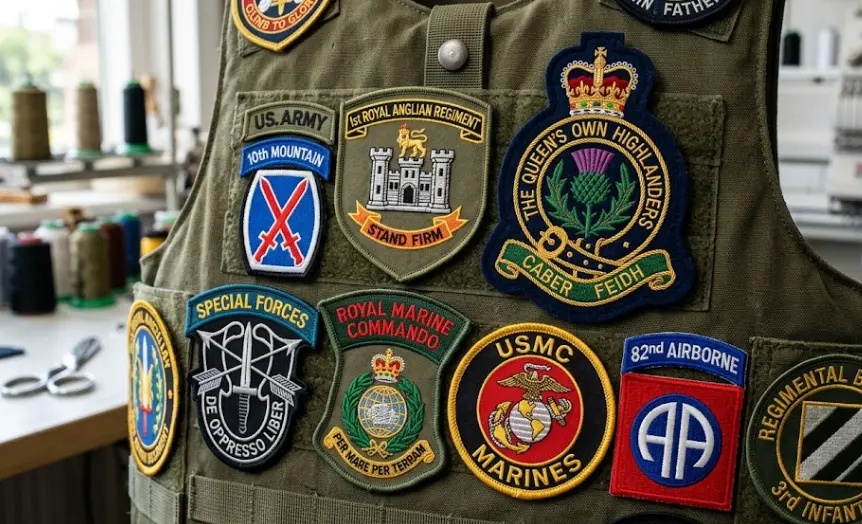
    When one holds this piece of history in his hands, one is indeed holding something special. For those interested, our guide below sheds light on how to identify military patches.

    How to Identify Military Patches

    The art of recognising military patches goes far beyond merely looking at a colourful design. It requires a deep appreciation for military heritage and a keen eye for manufacturing details. 

    From all the significant wars that occurred throughout the twentieth century, the need for fast identification of soldiers on the battlefield resulted in the creation of thousands of different custom military patch designs for divisions and brigades.

    Thus, nowadays we have a great number of patches for military personnel to explore and classify. By analysing their history, one can get an insight into changes in the army through decades.

    Identify Military Patches with Uniform Positioning and Placement Protocols

    Within the ranks of the British military services, there is never an element of coincidence about the positioning of a particular military patch on any uniform garment. This is because of the rigidly observed rules on uniform etiquette.

    For instance, when looking at a modern British Army combat uniform, the upper arms are the most critical zones to observe. The right sleeve conventionally displays the Union Flag alongside specific Tactical Recognition Flashes (TRFs), which are small, distinct colour blocks unique to individual regiments or corps. 

    Just below these, you will often find larger formation signs indicating the specific brigade or division. Conversely, an individual’s rank insignia, such as sergeant stripes or an officer’s rank slides, are worn centrally on a single chest strap in modern working dress, shifting away from the traditional shoulder epaulettes of older eras. 

    By noting exactly where a military patch is attached to a garment, you can immediately categorise whether it represents an overarching command structure, a specialised trade qualification, or the personal rank of the wearer.

    The Masterclass on Identifying Military Patches

    If you have recently acquired a collection of military patches or found a solitary morale patch in a vintage shop, your primary goal will naturally revolve around understanding its origins. Learning how to identify military patches is a process that blends historical research with tactile examination. 

    The first thing you need to do is analyse the general shape of the emblem. Infantry units typically made use of relatively simple geometrical shapes like circles, triangles, or shields, which would be easy to identify even from afar. 

    Having analysed the shape of your emblem, you now need to examine its core element. For example, animals, mythological creatures, swords, and lightning bolts have often been used to reflect special qualities and geographical locations of the units. 

    An eagle symbolising airborne units and an anchor indicating a naval unit are good examples of this. Having correlated your information with historical military databases, you will be able to estimate the period and the location in which the patch was used.

    Analysing Craftsmanship and Merrowed Borders to Identify Military Patches

    There is one detail about military patches that will tell you more than anything about their origins. An enthusiast will be able to gauge roughly how old the piece he is holding is just by running his thumb along the edge of the patch.

    It is easy to identify the period when it was made based on the type of edge it had. The patches created during the mid-century times and later tend to have merrowed borders that have an extremely dense overlock stitched around them to prevent fraying and give the emblem some texture and longevity.

    On the other hand, the vintage patches from WWII tend to have a cut edge where the design was embroidered onto a larger roll of twill fabric and then simply sliced out, leaving a flat, sometimes slightly frayed border. By closely examining these manufacturing hallmarks, you can confidently separate antique originals from modern reproductions.

    Inspecting Digitising and Embroidered Military Patches

    Beyond the borders, the density and direction of the thread itself offer vital clues. One should take these into account, as embroidered military patches are very technical works of art.

    Modern military patches are embroidered with the help of highly developed computer digitising programs that instruct high-speed computerised sewing machines to lay down thousands of stitches with flawless geometric precision.

    It leads to dense, uniform colour blocks and readable text. However, earlier military patches were made on sewing machines controlled by human hands or even on primitive automatic looms.

    The use of those older machines led to irregularities in stitching the pattern, which are commonly known as “snow,” as small parts of the underlining fabric are visible between the upper layer of threads. Noticing such imperfections helps in the military patches identification.

    Woven and PVC military patches on a tactical army jacket

    Material Evolution and Modern Synthetics in Military Patches 

    The materials in military patches have been greatly refined over time as new technologies and equipment have been developed. In the past, the main material for patches was either cotton or wool because of their accessibility and traditional appearance.

    Unfortunately, natural fabrics such as these could not withstand harsh conditions and tended to deteriorate rapidly. The present-day situation is radically different. While embroidered/woven thread is still very popular. Many of the more advanced units have begun to use completely different manufacturing processes for tactical patches. 

    The most common of these is 3D PVC patches. These modern rubbery materials are water-resistant, extremely durable, and can produce a high amount of detail, much higher than woven thread patches could achieve. 

    The type of material used in the production of the military patch immediately tells us how old the patch is. A patch made from woven or embroidered soft cotton twill was created many years ago, whereas a flexible PVC patch points directly to contemporary service.

    Decoding Colour Palettes in Vintage Army Patches

    Colour is arguably one of the most immediate indicators of a patch’s purpose and era. When sorting through vintage army patches, you will quickly notice a stark division between full-colour designs and subdued variants. 

    Full-coloured patches that had rich reds, deep blues, and bright golds were mostly used for the purpose of being worn in dress uniforms or for a time before camouflage and stealth were essential aspects of warfare.

    However, as technology advanced, especially in the era of the Vietnam War and other battles fought in the Middle East, the need for bright colours in uniform patches proved perilous for soldiers. 

    Hence, the development of subdued patches came about due to their use of dull colours such as olive drab, brown, and black. From your evaluation of how bright or subdued the colours of the customised military patch are, you can effectively tell what environment the patch was supposed to be worn in.

    Distinguishing Camouflage Adaptations in Modern Military Patches

    While looking for modern military patches, the study of their background materials and thread compatibility is as important as decoding their central symbols. In contemporary military logistics, military patches are carefully designed to match specific national camouflages so as not to reveal soldiers in disguise.

    While researching British military gear, one often finds military uniforms with MTP (Multi-Terrain Pattern) patches. These British-made military patches are designed according to the unique colour combination of soft greens, light tans, and earthy browns, reflecting British camouflages that provide concealment in multiple environments.

    On the other hand, American gear will be marked with military patches meant for OCP (Operational Camouflage Pattern) uniforms and have separate placement rules. Both of the camouflages aim to blend the personnel into the environment, but OCP uses a little bit different pattern geometry and a greater portion of specific foliage and sandy colours.

    Understanding the difference between MTP and OCP fabric materials is important since it makes it easier for researchers to determine the nationality of contemporary military patches.

    How to Identify Military Patches with Reverse Side and Hook-and-Loop Backings

    The first-time collector gets so fascinated by the front part of the item that he fails to notice how many clues there could be at the back of the patch. Always turn the patch around because what lies behind it serves as the timeline of technological development for manufacturers.

    If the patches were made in the very early twentieth century, you may find that they had raw threads sewn on the backing of cheesecloth or raw buckram. In the following decades, manufacturers used to add a layer of plastic or heat-sealing agent to the back of the patch to make it possible for soldiers to iron on patches onto their military uniforms.

    In today’s modern armed forces, convenience and modularity are key. Consequently, almost all authentic tactical patches issued today feature robust Velcro hook and loop backings. This allows service personnel to instantly swap out their unit identifiers, morale indicators, and medical information depending on the specific requirements of their mission.

    The Passion Behind Collecting Military Patches

    The pursuit of these historical artefacts is far more than a simple pastime. It represents a noble cause to keep the memories of these fallen soldiers alive. There are plenty of historians, military veterans, and archivists within the community who share a common passion for preserving these little pieces of history.

    Being part of the community may just be the best way for one to develop his or her identification skills. Being active in collecting forums and military museums, as well as being part of collecting military memorabilia fairs, will allow one to collaborate with fellow members to determine whether a particular item is indeed genuine.

    These types of collaboration will help one keep the memories associated with a certain patch intact. For example, when one traces a beautifully embroidered and cut-edge military patch to the particular squadron that once flew over Europe many years back, then it means that one is helping in immortalising the memory of that squadron.

    Crafting the Future of Tactical Military Patches

    Although the process of identifying vintage items can be fascinating, the designing of new military patches plays a significant role for those currently serving and the private companies. Never before has there been a higher requirement for quality identifiers.

    Whether you need high-visibility clothing as a contemporary security company or want to create exact copies of WWII insignias for your history group, the basic design principles stay at the core of the process.

    Transforming a sophisticated computer image into a sturdy and durable patch made out of fabric or PVC relies on an acute knowledge of how to control threads, backings, and borders. It is a very detailed procedure that results in a perfectly clear patch able to endure heavy wear.

    Frequently Asked Questions

    What is the most reliable method for authenticating a vintage military patch?

    The authentication process for an old item requires analysing multiple physical characteristics, including the thread material, which should be natural like cotton, and examining the fabric’s rear for raw backing, such as buckram or cheesecloth, rather than synthetic options.

    Can the type of border stitching determine the exact era of a patch?

    The style of a patch’s border aids in dating its production. Flat, frayed edges indicate World War II or earlier, while thicker merrowed edges emerged post-war. Modern patches often feature laser-cut borders, particularly in tactical emblems.

    Why are modern tactical patches transitioning to PVC instead of traditional thread?

    The transition to PVC is driven by contemporary military conditions. While embroidered emblems are visually appealing, they deteriorate when exposed to elements. PVC offers a flexible, durable, and water-resistant solution that can be easily cleaned after use.

    How should I preserve my collection of regimental cloth patches?

    Preserving vintage textiles requires clean or gloved hands to prevent deterioration. Store them in temperature-controlled areas with minimal sunlight exposure, as light can fade colors. Utilise acid-free shadow boxes or sleeves for optimal display and protection.

    Elevate Your Custom Military Patch Collection with Patch Makers UK

    Done reading our guide on how to identify military patches? For those of you who are committed historians and would like to recreate a historic military patch for your display, or if you are from one of the many service units that need tough and durable equipment. Patch Makers UK is your destination.

    We have a comprehensive understanding of the significance each patch carries, and we put in all the experience we have garnered in decades in our work of manufacturing custom patches for you.From the timeless thread designs with the traditional merrowed edging to the durable PVC design with its hook and loop system, there is no end to customisation here. If you feel that you have your own vision for your very own custom military patches UK, then get in touch with our design team right away.

  • How to Use Iron on Patches: Ultimate Patch Makers UK Guide

    How to Use Iron on Patches: Ultimate Patch Makers UK Guide

    Simply walk down any main high street in cities like Manchester, Bristol, or London, and you will find yourself noticing that uniform clothing is no longer in vogue. Instead, people are actively searching for ways to deviate from such standard high street designs and move towards secondhand stores and upcycling to make themselves an entire outfit that has its unique identity. 

    The easiest way to achieve this personalisation of your style would be to use patches that have been heat-activated. You could have these patches made for anything that strikes to be fancy, from a favourite local band to a design that you admire or even to cover up that one tear in your prized jacket. 

    Learning how to use iron on patches can give your clothes and gear an amazing touch, and you do not need any prior knowledge of sewing to make these emblems.

    Attaching the Adhesive Backing of Iron on Patches

    It is always best if one can grasp precisely what is occurring underneath when it comes to iron-on patches. If you have used any iron-on patch lately, then you must remember that the entire reverse side of the design would feel smooth and firm due to the presence of an additional layer of rigid plastic. 

    However, do not confuse this plastic layer for the packaging that needs to come off before applying the patch. In truth, this plastic serves as an advanced layer of thermoplastic glue. Under intense dry heat, this solid substance changes into a liquid form and flows straight into all the little spaces present between the fabric threads. 

    Once the adhesive becomes cool, it transforms back into its solid state and bonds with the fabric fibers to create a sturdy connection. One must understand these properties of the bonding glue if they wish to learn how to use iron on patch effectively. 

    Should you apply heat in small quantities, then the glue will remain solid, and the patch will not stick properly to the fabric. On the other hand, too much heat for too long will cause you to burn holes in either of the sides.

    Assessing Your Wardrobe for Material Compatibility

    However, before you turn on your iron and start tinkering with things, you should conduct a fabric audit on the garment that is to be modified. Heavy-duty natural materials that boast an incredibly dense and tight weave are best suited to this kind of modification. 

    Cotton, canvas, and thick wool felt can take extremely high heat levels in stride and thus make for an impeccable surface where customisation with an iron is concerned. So, as you are about to get down to business about how to use an iron on patch for the very first time in your life, check the care instructions sewn inside your garment. 

    If there is anything on the label warning you against excessive heat and if the fabric of your clothes appears to be light, slippery, and flexible, then you will have to think outside the box and take some precautions not to ruin your clothes in any way. Thin t-shirts and summery linen fabrics can do just fine, but only if extra protection is used.

    Addressing Tricky Synthetics and Technical Outerwear

    The one query that always confuses textile fans is rather easy: Can you use iron on patches on nylon or similar synthetic materials? Nylon makes excellent material for use in modern wind jackets, raincoats, backpacks, and even training wear because it is incredibly light and weatherproof. 

    Still, because nylon is created by synthetically combining plastics, it has an extremely low melting point. If you use the searingly hot household iron right against the nylon cloth, the latter will warp, shrink, and become unusable practically immediately. In such cases, one can try sewing on patches too.

    Although it is possible to transfer such designs onto a piece of synthetic clothing with extreme caution and a high temperature barrier between the heat source and the fabric, this technique is too dangerous for an amateur to use. 

    In cases like waterproof coats, technical jackets, or even backpacks made of nylon, it is best not to try ironing the patch in question to avoid damaging expensive technical wear. Using specialised adhesive or simply sewing the edge of the emblem with a needle and thread is much more sensible here.

    Essential Tools Needed Before You Begin Ironing on Your Patche

    The success of the technique depends a lot on ensuring that all prerequisites for creating a secure atmosphere have been provided before you start ironing. First of all, you will require a trusty iron, and the very first step you should take is checking its water reservoir. 

    If there happens to be any water in there, you have to drain it out entirely and turn the steam function off at its full extent. The presence of steam means there will be moisture and small pockets of lower temperature inside the garment, completely preventing the creation of new chemical bonds between glue molecules. 

    Second, avoid using the regular, springy ironing board that is too soft or padded. Soft surface material will absorb pressure that your iron is supposed to provide. It will not help the heated metal to push melted glue inside the garment fibers. It is better to use a solid wooden table or a good kitchen counter, covered with a single fold of a pillowcase made of cotton.

    Preparing the Fabric Bed for Ideal Adhesion of Customised Iron on Patches

    It must be noted that your clothing item must always be absolutely spotless before you apply anything to it, namely the adhesive. It is recommended that one should always make sure he or she is wearing clean clothes, particularly new and never-before-used ones bought right off the shop floor. 

    All newly purchased items are invariably coated with chemicals and fabric softener fluids that create a sort of slippery film on the surface of the fabric and that will repel the hot glue, making it prone to peeling away after a few days. Once the clothing item dries out completely, it should be placed on the prepared surface with the design side up. 

    In order to prepare it for application, the iron should be used with its temperature at the highest setting for ten seconds or so. It helps serve two purposes: flattening out the tiny wrinkles that may affect the positioning of the design and drying the underlying fabric to absolute dryness.

    Iron on Patches Technique Explained Step by Step

    Once the fabric has been warmed and prepared, it is time to proceed into the main part of the application. Position your design on your article of clothing with care, taking a second to pull away from the work and verify that your emblem is aligned correctly with seams and collars. 

    Finally, carefully position your pressing cloth above the design in order to prevent unwanted movement. When it comes to addressing the issue of efficiency in relation to how do you use iron on patches effectively without your patches falling off after being iron-pressed, the trick all lies in utilising nothing more than sheer dead weight and total immobility. 

    You should not move your iron side to side as if you were attempting to get wrinkles out of a dress shirt. Moving the iron in this way would result in a messy smudging of the glue underneath your design. 

    Rather, you should press the iron straight down on the pressing cloth with enough strength that your entire body weight is pushing down on the iron’s heating surface. Keep the iron stationary for twenty-five to thirty seconds before lifting it up and relocating it to an area of your emblem where there is no melted glue present yet.

    Securing the Iron on Patch Bond from the Inside Out

    After the initial pressing is done, avoid the instinctive urge of immediately pulling at the edges to check if it has stuck on. The adhesive is in its melted form and quite fragile at the time, and any interference would only result in the bonding process being compromised. In lieu of this, allow the area some time. 

    About a minute’s worth, until the temperature of the spot is brought down to normal levels. Afterward, take your shirt and turn it inside out, positioning yourself such that you have access to the reverse side of the material under the emblem. 

    Take your iron and press down on the reverse side of the fabric hard for fifteen to twenty more seconds. This step is important since the heat pulls the melted adhesive into the inner layers, weaving it within the weave of the material.

    A man preparing a denim jacket for ironing patches on.

    Transforming Workwear and Everyday Wear

    It goes without saying that denim is absolutely the best material for customisation, but due to the fact that it is an incredibly heavy, thick, and tight textile, some structural changes are required in order to learn how to use iron on patches for jeans. 

    It is important to understand that the thick and indigo colour threads serve as excellent insulators, so it will take quite some time for the heat to reach the glued side of the fabric.

    When it comes to customisation of the legs, pockets, and knees of heavy denim jeans, you may safely spend about thirty-five seconds to press your patch, applying maximum physical pressure. 

    This is necessary due to the fact that jeans are constantly stretched during walking and sitting, and as a result, the edges of the emblem constantly face mechanical pressure. In order to prevent them from detaching, experienced customisers use a small running stitch at the edges of the emblem, thus creating an impeccable backup.

    Laundering and Caring for Your Upcycled Wardrobe

    First of all, congratulations because now your unique symbol is firmly attached. However, the task at hand now is only one proper maintenance to preserve your hard labour throughout its entire lifespan. 

    First of all, whenever you wish to clean your clothes decorated with such elements of heat-applied printing, it is important that you turn the item completely inside out before you place it into a washing machine. 

    It ensures the raised elements of embroidery are completely protected against any damage that may come from interaction with rigid metal zippers, plastic machine drums, or hard buttons.

    Secondly, use a cool cycle when you wash such clothes up to thirty degrees Celsius or less, as recommended. Moreover, avoid biological washing powders, since heat could cause gradual reactivation of the adhesive and result in the destruction of the design. 

    At last, it is very important that you never place such clothes in a tumble dryer, since it could significantly deteriorate the condition of the glue and destroy the edges. Instead, always opt to air-dry your shirts, jackets, and trousers naturally on a clothes maiden or an outdoor washing line. Other than that, removing iron on letter patches will be essential if you are really curious regarding iron on patches removal. 

    Frequently Asked Questions

    What should I do if the pointed corners of my patch start to lift up after a few months of heavy wear?

    If the edges of your patch lift over time, do not worry. This minor peeling means the adhesive has detached. Lay the garment flat, cover with a pressing cloth, and use a hot, dry iron for fifteen seconds to reset the glue.

    Can I safely use a modern steam pod or garment steamer to apply these adhesive designs?

    Never use a garment steamer or steam pod to bond fabric with heat-activated adhesives. Steamers provide moisture instead of the intense dry heat and pressure needed, damaging the adhesive’s properties.

    Is it possible to remove an patch from a shirt if I want to change its placement later on?

    Removal is achievable by placing a pressing cloth over the design and applying a hot iron for about twenty seconds to melt the adhesive. Once melted, use tweezers to peel the patch off, noting that some glue residue may remain.

    Does the thickness of the patches alter the amount of time I need to spend pressing it?

    The design’s thickness significantly affects your timing strategy. Thicker embroidered patches require an increase in pressing time by five to ten seconds compared to thin woven designs to ensure heat penetrates adequately through multiple dense thread layers.

    Craft Your Next Iron on Patch Piece with Patch Makers UK

    Joining the exciting journey of designing your unique clothing through customisation is an excellent choice and a sustainable one too since you can customise and breathe life into old clothes that would have been left to rot in the back of your closet. 

    With the information needed on how to manage different materials, understand how heat works, and effectively care for the completed design, there are virtually no limitations to what you can do with the skills acquired. 

    If you feel adventurous and eager to begin a journey into the wonderful world of textiles, check out our wide-ranging and beautifully curated selection of designs at Patch Makers UK. Our patches are of high quality and feature outstanding details, which make them easy to apply and last longer.

  • How to Iron on Patches on Clothes: Step-by-Step Guide

    How to Iron on Patches on Clothes: Step-by-Step Guide

    This is certainly a situation we have all encountered at least once when faced with our wardrobes, looking at the same clothes as ever and finding everything somewhat monotonous. 

    Recently, there has been a huge trend of nostalgia coupled with the necessity to adopt more sustainable ways of dressing. Thus, bespoke fashion customisation has made a tremendous comeback in the UK. 

    There is nothing quite as exciting as making an ordinary item of clothing into something unique and meaningful, which says a lot about who we are, where we have been, or even our favorite music bands. 

    This is the point where the importance of custom clothing decoration comes to its full value. In case you have been looking for some practical advice on how to iron on patches, then you are in luck because you have come to exactly the right spot. 

    Taking an ordinary mass-produced piece of clothing and transforming it into something extraordinary does not demand any expertise in fashion design or access to an expensive sewing machine.

    Understanding the Basics of Heat-Activated Adhesive for Iron on Patches

    While we may just go ahead and jump straight into the process, it is crucial that we take some time to first educate ourselves about the basic principles underlying the whole procedure. 

    An iron on patch will always be characterised by its reverse side being very stiff and having a very shiny, plastic-like finish. This is basically a special adhesive that will only become effective when it comes into contact with the heat produced by your domestic iron. 

    The stiff glue will melt and bond itself with the woven fibres of the cloth once it is melted down. But it must be noted that there are different types of cloth out there, and knowing this basic fact will be key to learning how to apply iron on patches effectively. 

    Natural fabrics such as thick cotton and denim are the best base for this glue since they can handle the immense heat needed for this without burning up. But polyester is sensitive and can melt under immense heat.

    Preparing Your Workspace and Gathering Your Tools

    The first thing that needs to be done before beginning the ironing process is the preparation. It separates the successful procedure from the one ending in failure. There is no doubt that just sticking any patch to any jumper would be a wrong step to make.

    In order to learn how to iron on a patch correctly, it is imperative to acquire several items. First, you will need your garment, an ironing board, an iron that provides sufficient heating, and finally, a pressing cloth. 

    One should not underestimate the importance of the last item mentioned. Any old tea towel, pillowcase, or scraps of muslin will suit you well enough. The purpose of this piece of fabric is to serve as a layer between your very hot iron and delicate fibers of your design.

    That is why the pressing cloth becomes an effective means of protecting your patch from melting under the influence of high temperatures. In case you are working with sophisticated designs and want to learn how to iron on embroidered patches, it would be silly not to use it.

    The Crucial Preparatory Steps for Your Garment

    With all the necessary tools arranged on hand, you should get ready for working on the canvas. First, wash your clothing item and dry it. Garments bought brand new from any fashion house are usually treated with invisible chemical substances such as sizings and softeners to make them impermeable to adhesion. 

    After your piece of clothing is clean and dry, set it on the ironing board. Heat your iron at the highest temperature suitable for your garment without enabling its steaming function. Steam and water are absolutely incompatible with melted glue. 

    Therefore, it is important to keep your ironing surface dry. Apply the hottest part of your tool to the area where your badge is going to be ironed. This way, you will ensure that there is no water left on the surface. 

    Moreover, the fibers of your textile will loosen and become more receptive to the glue. When asked how to iron on badges, we always remind people of this crucial pre-heating phase.

    The Master Technique for Flawless Application of Iron on Patches

    Here comes the part that will put all your hard work to test. Slowly place your design over the newly warmed spot on the fabric. Make sure it is placed perfectly straight, because once the glue hardens, moving it even slightly will not be possible. 

    Now, if you have always been wondering how to iron on an iron on patch for clothes, you should know that it is all about pressure and patience. Cover the design with your special pressing cloth and make sure you don’t disturb it. 

    Pick your iron and place it firmly onto the cloth covering the design without lifting it from one spot. Do not rub the iron as if you were ironing wrinkles. By moving your iron over it, you will only distort your design and smear the glue. 

    What you need to do is press down the iron firmly by putting pressure from your entire body weight. Leave it in one place for approximately fifteen-twenty seconds. Then remove it and repeat it wherever it may be necessary. Knowing how to iron on iron on patches correctly is the first step to correct patching.

    Securing the Bond from the Reverse Side

    But wait, there is one more crucial step to ensure durability. Take off the pressing cloth and give the area some time to cool down so that you do not burn yourself. Turn the garment totally inside out. 

    It is important at this stage to absorb as much melted glue deep into the fibres of the fabric as possible. Place the garment on the ironing surface so that the back side of the place where you have attached the design faces up. 

    Iron that part of the fabric for another fifteen seconds with a hot iron. In most cases, the pressing cloth is not needed at this point, except if your shirt or T-shirt happens to be very delicate. 

    In doing this, you will be forcing the glue deeper into the fabric through its weave, making the connection between the two materials extremely strong and durable. This is how to iron an iron on patch like a professional!

    Customising Your Favourite Shirts

    The most common type of clothing that tends to be popularly used for customisation is shirts, ranging from a regular flannel shirt and button-down shirt to t-shirts. Iron on patches on shirts need care about the fabric mix of the particular item. 

    Standard t-shirts usually have a mix of either cotton or sometimes cotton blended with polyester, which makes them able to resist high temperatures for attaching an iron patch on shirts. 

    As compared to outer garments, shirts are made from much more delicate materials, hence the need to ensure that the surface on which you will be ironing is completely flat and rigid. 

    You should always take extra caution whenever you wish to iron on a patch to a shirt, owing to the flexibility of the fabric. When placing the designs, one must ensure that the fabric is not stretched in any way, thus leading to wrinkles after the glue dries up.

    In case one wants to know how to apply iron on patches safely on the shirt pocket, one can easily put a card in between before ironing so that the shirt pocket does not stick to the actual shirt.
    A woman wearing a denim jacket with multiple iron on patches.

    Tackling Tough Denim and Heavy Jackets

    Denim is the king of customisable clothing beyond any question. Denim, in whatever its incarnation. Be it the Levi’s jacket from the past decade, a perfect pair of worn-out jeans, or the brand-new pair that has not had enough time to become worn out yet. They are awesome fabrics that give you excellent canvas. 

    However, owing to the thickness and tight weaving of denim cloth, how to iron on patches takes some modification in terms of the time required for pressing. Heat needs much more time to pass through all these dense blue threads and get to the adhesive substance under the patch. 

    In case you need to iron on patches for jeans or iron patch on thick denim jackets, feel free to increase the pressing time and give each portion at least thirty seconds under your iron. Moreover, do not hesitate to use some additional pressure, since it can only help you get better results. 

    If you choose to iron on patches on jeans, especially in places such as pockets or knees, which constantly bend and flex during the day, reversing the process mentioned above becomes essential. Otherwise, the edges of your design would start lifting after a few days of wearing the pants.

    The Tricky Business of Synthetic Fabrics

    Today’s clothes contain a great deal of synthetic materials, posing another set of problems. Should you want to iron on patches on polyester, nylon, or any sportswear, you will have to take care. Polyester is, quite literally, plastic. 

    If you apply a very hot iron to it, not only will the polyester fabric deform, melt, or burn shiny before anything, but most likely before the custom iron on patches even becomes bonded. In order to safely attach an iron on embroidery patch to polyester fabric, you will have to set your iron on a medium or “synthetic” setting. 

    Since it is low heat, you will have to hold your iron over the glued area longer to melt the glue. Make sure you have a thick pressing cloth. Do not forget to monitor the process. 

    For things such as raincoats or workout gear, you may be planning to attach iron on appliques just for looks. Here, if your polyester is so sensitive that it cannot endure medium heat, it is best to completely forget about iron and sew the patch edges instead.

    Creative Solutions for Those Without Traditional Tools

    Life goes by, and sometimes you end up traveling, attending a festival, or living in a university residence hall without having an iron at home. You can be desperate enough to mend your garment or add a stylish new patch to it, prompting the question: How to iron on a patch in a crisis situation? 

    Luckily, there is a way to iron on patches without an iron, using only hair straighteners. Hair straighteners function as a perfect double-sided mini press. You simply need to put the design exactly where you want to have it on the sleeve, collar, or hemline of your clothes. 

    All you need to do is to heat your hair straighteners, put a very thin protective cloth layer on the patch, and put the heated ceramic plates down on the back and front side of the fabric at once. You should hold it for about twenty seconds. 

    In case one needs to attach an iron on a badge to the center of the shirt in such a position that it cannot be reached by any other straightener, the usage of good-quality washable fabric glue can be considered to be an excellent substitute for trying to iron on a patch without an iron. One just has to apply the glue to the backside, put it on the fabric, keep something heavy on it overnight, and the job is done.

    Ensuring Your Custom Creations Last a Lifetime

    After ensuring that you manage to iron a patch on the garment properly, then it follows that you will want it to remain firmly attached for many years to come. In other words, you should be able to take good care of your iron on patch items. 

    Always ensure that any time you are washing your customised T-shirts, pants, jackets, and others, you turn them inside out as you place them in the washing machine. This will help to prevent your embroidered threads from being snagged by zippers and buttons.

    Furthermore, it stops the washing machine’s agitator from being too rough in its movement as it washes your customised apparel. Here, it is important to wash your bespoke garments in cold water through gentle washing cycles since hot water may reactivate the glue and make your design come off.

    In addition, you should avoid placing your bespoke garments in the tumble dryer since it is quite hot, thus making the iron on embroidered patch peel off. Air dry your bespoke clothing, such as jeans, shirts, and jackets, by hanging them outside or inside on the maidens. These tips, if followed, prevent iron patches from falling off.

    Frequently Asked Questions

    Can I easily remove a design once it has been firmly ironed onto my clothing?

    Heat-activated adhesive is permanent but may be removable with patience. Reheat with an iron and pressing cloth to soften the glue, then use tweezers to peel away the design. Expect stubborn residue that may need specialised fabric adhesive removers for complete cleaning.

    Why are the intricate edges of my design starting to lift and peel away after just one wash?

    Premature lifting of edges typically indicates insufficient heat or inadequate pressure during application. Another reason may be ironing the fabric’s front instead of the reverse. You can fix this by flattening the garment and re-ironing with a pressing cloth.

    Should I use the steam setting on my iron to help the heat penetrate the fabric better?

    Never use steam when applying adhesive-backed designs, as moisture disrupts hot melt glue bonding. Ensure the iron’s water reservoir is empty and the steam dial is off for proper adhesion.

    Is it strictly necessary to sew the edges down after I have already ironed the design firmly in place?

    Using high-quality adhesive is effective, but adding simple stitches around the outer border is recommended for items experiencing heavy wear. A quick running stitch can provide extra security, ensuring designs remain intact despite glue weakening over time.

    Learn How to Iron on Patches with Patch Makers UK

    Tailoring your clothes with a custom design is an innovative way to give them a whole new lease of life and highlight your distinctive fashion sense. With the help of these tips that will guide you in how to iron on patches just like a pro and knowing how to work with difficult fabrics and form durable bonds, your only restraint is your imagination. 

    For those of you who have been struck by inspiration and are ready to embark on their next project, discover our huge range of high-quality designs at Patch Makers UK. At Patch Makers UK, we are proud to offer you the finest quality designs that are highly durable and very easy to apply.

  • Custom Military Patches UK: History, Types & Meaning Guide

    Custom Military Patches UK: History, Types & Meaning Guide

    A military uniform commands respect the moment you see it. But look closer and you will notice it is not the uniform alone that tells the full story. It is the patches attached to it.

    At Patch Makers UK, we understand the importance of the small fabric patches attached to the uniform. We also know that they are more than just fabric patches and moulded rubber. They are symbols of honour, symbols of hardships endured together, and symbols of pride in the unit.

    For those who are still active in service and need regulation-compliant items, or for those who simply wish to remember the past deployments, it is vital to understand the nuances of military patches. The demand for such tactical insignia has never been as great as it is in the year 2026.

    A Brief History of Military Patches UK

    In order to fully understand today’s military gear, one should cast back to its origins. Wearing distinctive symbols on clothing has a long history, yet the idea of British military patches as we know them gained momentum during those difficult times of the First World War. 

    With soldiers’ uniforms turning into a canvas of mud due to trenches, officers badly needed means for distinguishing between various units. They decided to sew simple geometric shapes onto tunics. Soon enough, this idea led to the appearance of more elaborate designs that flourished by the time of WWII. 

    In fact, by the time of the Second World War, patches featured stylised animals, heraldic imagery, and bold geometric forms. They helped create strong ties within military groups. All this rich history still affects the design of contemporary UK military patches produced by the UK industry.

    Understanding the Meaning Behind the Threads of British Military Patches

    Each and every one of those on a uniform has a distinct army patches meaning and purpose, conveying essential information in a matter of milliseconds. Learning how to identify military patches requires knowledge of the most widespread types, including military unit patches, or Tactical Recognition Flashes (TRFs), in British military jargon.

    Such patches reveal a great deal of important information about where in the allied forces each soldier comes from by merely glancing at their uniform. Alongside these, you will frequently find custom military ID patches, which are critical for battlefield safety and logistics. These often display a soldier’s blood type, allergy information, and identification number.

    We also see a massive demand for custom military name patches, ensuring that every piece of kit and uniform is easily identifiable within a crowded barracks. The meaning behind these items goes beyond mere administration. Making the embroidered name patches and wearing them makes these patches the literal markers of a soldier’s identity and their place within a massive, structured brotherhood.

    Global Perspectives: American and International Influences

    While our focus is naturally on the UK, tactical gear is a global industry, and different nations have heavily influenced the aesthetics and functionality of modern custom uniform patches. For instance, American military patches are famously bold, heavily relying on vivid colours and deeply intricate embroidered crests that tell a literal story of a unit’s history. The US system of displaying current and former wartime service on different shoulders has created a massive culture of patch collecting worldwide. 

    Many international military traditions lean toward functional design, using colour coding and standardised symbols to convey branch and rank information quickly. 

    Velcro military patches in the UK.

    Exploring the Different Types of Military Patches in the UK

    While selecting an emblem for your team or individual attire, you should note that the type of material used plays a critical role in shaping the final design. Traditionally, embroidery patches are preferred by those who stick to tradition. Embroidered military patches UK use tightly woven threads to produce a highly textured patch with a timeless appeal. 

    If you desire high-quality products that match your dress uniform, our custom embroidered military patches are the best option. In combat, your gear will be tested, hence the demand for more durable patches. If you are looking for a military patch that offers superior durability, then PVC military patches are the most ideal. The durable rubberised plastic will withstand the harsh conditions without fading or wearing out. 

    You can easily wipe the dirt with a wet cloth when using military patches that are made of durable material. Besides, the patches offer a 3D effect, which makes any logo and text stand out. Iron on military patches will come in handy if you need a more permanent solution for your attire. With the patches, you will not require any sewing kits to fix the emblem on your clothes.

    The Rise of Morale Patches and Humour Patches

    Let’s be honest, military life is not all parade grounds and serious operational briefings. It involves incredibly long hours, immense stress, and periods of extreme boredom. To cope with this, soldiers have developed a famously dark and robust sense of humour.

    This has given birth to the incredible popularity of morale military patches. These are unofficial, off-duty badges that soldiers swap, collect, and stick onto their rucksacks and the inside of their vehicles. 

    We produce thousands of custom military morale patches every year, ranging from humorous designs filled with inside jokes and motivational quotes to popular culture references reworked for a military context.

    In situations when you need to take your mind off things and get a chuckle, it is precisely then that funny military patches have their place. From ironic comments regarding the quality of the rations to sleep-deprived humour, these patches serve as a genuine pressure valve for service members, a small way to find lightness in a demanding environment.

    Decoding MTP Patches Placement Rules

    If you are a serving member of the UK armed forces, you cannot simply stick a MTP patches UK wherever you fancy. The current standard issue uniform is the Multi-Terrain Pattern, and there are incredibly strict rules regarding military patch MTP placement. 

    On the current issue combat shirts and smocks, the blanking plates on the arms are designed specifically to host your insignia. The Union Flag is strictly worn on the left arm. Your Tactical Recognition Flash sits just below this. 

    The right arm is generally reserved for brigade or division emblems, alongside essential qualifications like parachute wings or commando daggers. Placement can vary by regiment and role, so always verify with your unit. Because modern uniforms use hook-and-loop systems rather than requiring soldiers to sew things on, Velcro military patches are completely mandatory for operational clothing. 

    This system allows troops to quickly strip their uniforms of identifying markers if they are captured or need to operate anonymously. When you order custom military Velcro patches UK style from Patch Makers UK, we ensure the sizing perfectly matches standard Ministry of Defence blanking plates so you always look squared away.

    Wearing Your Pride: Hats and Jackets

    The appeal of these tactical designs has massively overflowed into civilian fashion and veteran streetwear. One of the most popular trends we are seeing this year involves military hat patches. 

    Tactical baseball caps and operator hats feature a small square of loop fasteners on the front, allowing the wearer to swap out their allegiance or mood daily. Whether you want a custom hat with patches to advertise your civilian business or to show off a subtle veteran-owned brand, the versatility is brilliant.

    Vintage clothing lovers are always finding ways to make use of their leftover clothes and create fantastic military jackets with patches, which have badges that speak for themselves through a new fashion language. Placing a bright and historic badge on the olive green jacket is what makes the whole difference.

    How to Create the Perfect UK Military Patch Design

    Transforming a design from the early sketches you jot down in your notebook to a functional item is an exciting venture. We have made that process straightforward.

    For those looking to create custom military patches, the first step involves fixing your artwork. You do not have to be an artist, as we can transform your crude doodle into a digital file ready for manufacture. 

    When designing custom patches military enthusiasts always ensure that there is a blend of detail and clarity. An overload of text can only appear as gibberish. Therefore, the use of clear and bold lines is preferred. 

    The next stage is selecting the backing. Many of our tactical clients tend to prefer military Velcro patches UK, allowing for frequent swapping on tactical rigs and helmets.

    In case you want to place an order for an entire team of airsofters or a group of veterans, you will be searching for custom made military patches, which can provide uniformity throughout the entire collection. 

    At our company, we have always boasted that we manufacture some of the best military patches in the country. This is because we make sure that each stitch in each one of our products is perfect and that each poured layer of PVC material can withstand any abuse that may be thrown its way. 

    The process of manufacturing custom military patches for you will depend completely upon your needs, whether they are intricate custom military patches UK for formal events or rugged custom military Velcro patches for weekend mud wars.

    Frequently Asked Questions

    What exactly is the standard turnaround time for a bespoke order from your workshop?

    It is usually based on the complexity of the design and the type of materials used, but our usual production period is normally only a couple of days before sending out the initial digital proof. Following the approval of the digital proof, the normal production time for embroidery is approximately two weeks before delivery. If you are using moulded PVC, it may sometimes take a few extra days since we need to cut a metal mould to form the liquid rubber.

    Can civilian airsoft teams and paintballers legally wear realistic tactical insignia?

    Of course, it is perfectly fine for civilians who are passionate about the hobby to put their own tactical clothing as well as personal designs on the battlefield. The only limitation here is a purely ethical one where people should not be wearing any official qualification badges such as the SAS winged dagger or medals that they do not deserve because it is very rude and inappropriate to do so. When organising any Milsim games or events, we would encourage players to create their own crests to establish their own legacy.

    How do I properly wash and care for garments that have these items attached?

    In case you are wearing hook-and-loop fasteners, then the best way would be to just remove them before putting the combat shirt or jacket through the laundry. This will ensure that not only does the badge retain its colour but also prevent the loops from catching in the wash. In case you are wearing clothes with thread work, it is recommended that you turn the garment inside out and use a mild wash setting to avoid any fraying or colour bleeding onto the neighbouring fabrics.

    What type of image file is best to send when submitting a new design idea?

    We are very flexible and can handle anything you throw at us, but giving us an extremely high-quality vector file such as an AI, EPS, or PDF provides our team with the best possible starting point. In the event you do not have access to such a file, ensure that the JPEG or PNG you provide is of the highest quality to give us enough information to trace. Even if you only have a sketch drawn on a napkin, our talented art department will create a masterpiece for you.

    Get Ready to Craft Your Legacy of Custom Military Patches with Patch Makers UK

    After reading our guide, you are an expert in how to identify military patches and well aware of the military patches meaning and purpose. It is simply not acceptable to give anything else but perfection to your uniform, your kit, or your team. That is what we aim to achieve here at the Patch Makers UK.

    We are extremely dedicated to turning your years of service, your brand identity, or the sense of humour of your group into superb, combat-ready military patches.

    We are well aware of the tough conditions under which tactical equipment is used, and our promise is that our items can handle anything that nature can throw their way, looking stunning all the while.

    Do not use cheap kits that fall apart after one training session. Talk to our team of designers now and let them show you how it is done. Get a free quote today.